

It is 2:30 in the morning by the Ethiopian clock, half past eight to everyone else, and there are already four people outside a twelve-machine communication center a few streets down from Sidist Kilo. One wants a letter typed in Amharic. Two are here to open a government site that neither of their phones will load properly. The fourth needs three pages printed and a photocopy of his ID. The sign on this door says communication center. The sign two doors down says cyber center. The exercise book on the counter is the same in both: name, machine number, time in, time out, minutes. Whoever is on duty writes it down.
That exercise book is what this article is about. Not the hardware, not the licence from the trade bureau, not the paint. The book, the three kinds of money that cross the counter of an Ethiopian communication center every day, and why keeping them straight by hand stops working somewhere around the eighth machine.
What a communication center actually sells
Start with the list, because it is longer than anyone who has never run a communication center expects.
Typing, in Amharic and in English. Letters to a kebele office, CVs, job applications, the form a cousin abroad needs filled in and scanned back the same afternoon. Printing and photocopying, black and white by the page. Colour costs more per page. Scanning. Lamination for the ID card that just came out of the printer. Internet time on one of the machines, sold by the minute. Airtime top-ups. Phone charging when the power has been off all morning at home. And, in a growing number of shops, a PlayStation or two in the back corner with EA FC on it.
Those services are priced three different ways. Typing and printing are per item, a page is a page. Internet time is per minute, and the minute is the unit customers in Ethiopia have always thought of. The PlayStation is per game or per half hour, depending on the shop.
That is the whole problem in one sentence. One counter, three price lists, one exercise book. (Two books, if the owner keeps a separate one for the printer, and many do.) A customer who types a letter, prints it twice, then sits down for twenty minutes to email it has generated three lines in three places, and by 7 in the evening the person who wrote them has gone home.
The fix is not a better exercise book. It is putting all three on one screen. Cafe management software like iCafeCloud was built around the per-minute side, the machines, but its POS module carries the per-item side too, so the page count and the minute count land in the same shift record with the same timestamp.
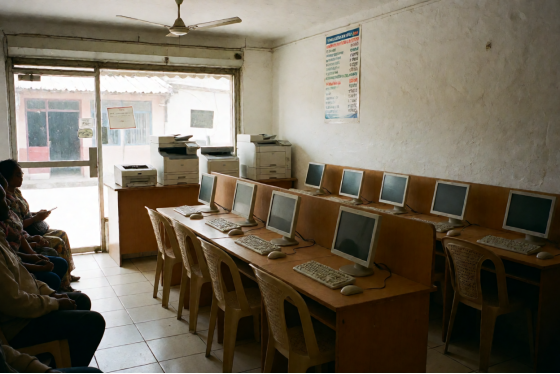
Customers at the workstations of a small communication center in Addis Ababa on a weekday morning
The minute clock on the counter
Ethiopian communication centers charge the internet by the minute. Rates have moved a long way since the birr was floated in 2024, so no rate is printed here, but whatever your per-minute price is, the arithmetic at the counter is the same: time out minus time in, times the rate, rounded whichever way the owner has decided to round.
That arithmetic goes wrong in three predictable places.
The first is the start time. The customer sits down, the operator is halfway through a photocopy, and the start time gets written five minutes late or from memory. The second is the machine swap. Machine 3 freezes, the customer moves to machine 7, and the book now has either two entries or one wrong one. The third is the shift change. The afternoon person arrives, the morning person leaves, and the six people currently sitting at machines have start times in handwriting the new operator cannot quite read.
Take the machine swap first, because it is the one nobody plans for. Treat it as a session transfer, not a new session. In the admin panel you move the running session from machine 3 to machine 7 and the clock keeps counting. One entry, one price, no argument at the counter afterwards.
Software handles the rest. The session starts when the customer logs in and ends when they log out or when their prepaid minutes run out, at which point the machine locks itself. The operator sees all twelve machines on one screen: who is on which one, how long they have been there, how much time is left. (Try the counter side on the live demo before you buy anything. It is the fastest way to find out whether the layout suits the way your shop already works.)
Honestly, the prepaid part matters more than it sounds. The student who buys sixty minutes on Monday and uses twenty-five of them is a regular you want back on Thursday. Sell those minutes onto a member account, not onto a scrap of paper. Paper gets lost and gets handed to a friend. The account follows the person, the remaining thirty-five minutes are on the screen when they walk back in, and the report shows you who your regulars actually are.
iCafeCloud member list showing account balance, remaining time and member group for each customer
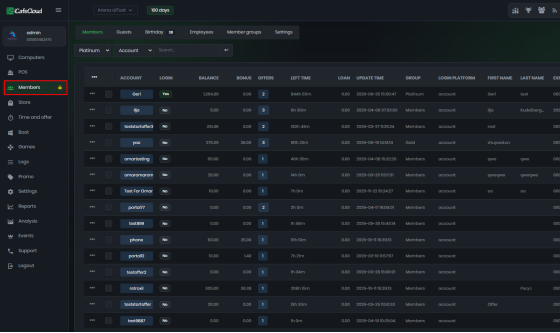
The screenshot above is the member list from the iCafeCloud admin. For an Ethiopian shop the column that matters is the one marked left time. That is the minutes the customer still owns, and it survives a power cut, a shift change, a machine swap, without anyone writing anything down.
Results week is the closest thing to a peak
Every trade has a season. For a communication center in Addis it arrives at the end of August.
That is when the Grade 12 national results come out. This year 563,858 candidates registered. Results went up on result.eaes.et, on the EAES Telegram bot and by SMS to 6284, and for about a week every shop near a school or a campus had a queue of parents who wanted the result printed, because a screenshot on a phone does not feel like a certificate. University placement follows a few weeks later. Then there is the Fayda registration push, which sends people in to look up centres and print confirmations, and the new online passport system that runs off Fayda and asks for scanned documents most households cannot produce at home.
None of those weeks is really about internet minutes. They are about printing and scanning, plus someone at the counter who can find the right page on a government site in under a minute. But they are also the weeks when the exercise book collapses, because the shop is doing thirty minutes of typing and forty pages of printing while eight machines are browsing, all at the same time.
Three things worth doing the week before:
- Sell prepaid balance to students and parents ahead of results day. Money comes in early, and the queue moves faster because nobody is counting coins.
- Put students in their own member group at their own rate. In iCafeCloud a group carries its own price and its own discount thresholds, so the student price applies itself without the operator remembering.
- Open last year's report for the same two weeks and look at what the shop actually did, not what it felt like. The numbers usually say the printing counter earned more than the machines, which tells you where to put the second person.
How does one Ethio Telecom line feed twelve machines?
Bandwidth in Ethiopia is a fixed monthly cost with a very visible ceiling. Ethio Telecom's unlimited fibre is 1,300 birr a month for 10 Mbps, 2,500 for 20 Mbps and 5,900 for 50 Mbps, VAT included, on the tariff page as of this week. Safaricom Ethiopia's unlimited packages went up 20 to 25 percent in December. Whatever the communication center pays, twelve machines and a printer share it.
On a normal Tuesday that is fine. On Tuesday EA FC pushes a 40 GB update to the two PCs that run it, the typing customers cannot load a webmail page and the whole communication center notices.
Two habits fix this, and the annoying part is that both are about discipline rather than equipment. The first is scheduling: big downloads and Windows updates happen after the last customer leaves, not at 4 in the afternoon. The second is not downloading the same thing twelve times. Game licences sit in one shared pool, so each title is bought once and assigned to whichever machine is running it at the moment. And if your shop is more game zone than typing room, the diskless route is worth a look: with CCBoot the games live on one server image, the update happens once, and every machine picks it up on the next reboot. The bundle with iCafeCloud exists for exactly that kind of shop.
When the light goes, the balance stays
Power cuts in Addis are not news to anyone reading this. EEU itself said it had identified more than 25,000 outage-related faults in the capital. A communication center loses power mid-afternoon with nine customers sitting down, and the question is not whether the lights come back but what happens to the nine sessions.
With the exercise book, it is an argument. The customer says fifteen minutes, the operator's watch says twenty-two, and the book says nothing because nobody wrote the stop time when the room went dark.
Put a UPS on the counter PC and on the server, even a small one. That keeps the record alive long enough to close cleanly. In practice the sessions live on the server, not on the customer's machine, so when power returns the remaining minutes are still on each account and the customer sits back down where they were. The day report will show a gap between 2:40 and 3:15 with nothing in it, which is the honest version of what happened and the only version you can plan around. Count the gaps over a month and you know exactly how many hours the grid cost you.
The PlayStation corner keeps a different score
Some Addis game zones charge per game rather than per hour. One in Edna Mall quotes 50 birr a match. In a communication center the console is usually one or two units in the back, and it is tempting to leave it off the system because it is "just the PlayStation".
Do not. Console time is billed and controlled from the same admin panel as the PCs. Set it per game or per half hour, whichever your customers expect, and when the time is up the console cuts off the same way a PC locks. The point is not control for its own sake. It is that the PlayStation's takings show up in the same shift report as everything else, instead of in someone's pocket.
The end-of-shift count is three numbers
Money arrives at the counter three ways now. Cash. A telebirr transfer to the shop's number. And, more and more, a static telebirr merchant QR code taped to the counter, where the customer scans and types the amount themselves. Ethio Telecom expects merchant numbers to reach around 569,000 this fiscal year, up from 440,000, and the little laminated QR stand is now as common on a cyber center counter as the stapler.
Three payment rails and three price lists make nine ways for the shift total to go wrong.
So the count at shift change is three numbers, not one. The cash in the drawer. The telebirr statement on the phone. And the shift report from the system, which is the only one of the three that knows what was sold. iCafeCloud reports run per shift as well as per day, with earnings, expenses, member activity on them, so the afternoon person signs off against a number and not against a feeling. If the three do not match, find out then. Not at the end of the month, when whoever was on duty has forgotten what the 340 birr at 4 o'clock was for.
Diagram of per-minute sessions, per-page services and per-game console time flowing into one shift report
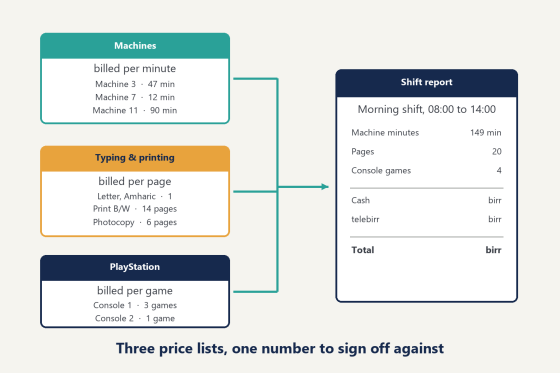
The report separates cash from telenir only if the payment method is recorded at the till, which is one tap. Do that tap. It is the difference between a report you trust and a report you argue with.
What a cyber center pays for the software, in birr
The prices are in dollars on the per-PC price list, so here they are in birr at this week's rate, roughly 162 to the dollar.
iCafeCloud is 2.50 dollars per PC per month, about 405 birr. Paid yearly it drops to 2.00 dollars, about 324 birr. For twelve machines that is around 4,860 birr a month, or 3,888 on the annual plan. Set that next to the 2,500 birr Ethio Telecom charges for the 20 Mbps line and it sits in the same part of the ledger: a fixed monthly cost, smaller than the rent, that a communication center cannot run properly without. The bundle with CCBoot for a diskless game zone is 4.00 dollars per PC monthly or 3.20 yearly.
Trials start at ten machines and run fifteen days, extendable to thirty. You apply for a trial licence from inside the software after install, and the key arrives over WhatsApp or Telegram. Support is in English, around the clock, from a company that has been doing this for venues in more than 90 countries.
Cross a border and the sign changes but the counter does not. In Nairobi the shop is a cyber. It charges 50 to 100 shillings an hour, prints at 5 to 10 a page, and its busy weeks are eCitizen deadlines and KRA filing rather than Grade 12 results. Kampala and Dar es Salaam run the same way. Same three price lists, same three payment rails, same exercise book.
Which brings it back to the book on the counter at Sidist Kilo. It works until the day it does not, and that day is usually a results week. Put ten machines on a trial before the next one, run the shift count against the report for a fortnight, and see whether the three numbers match more often than they do now. That is the whole test for a communication center. Not whether the software is clever, but whether the count at 8 o'clock is boring.