

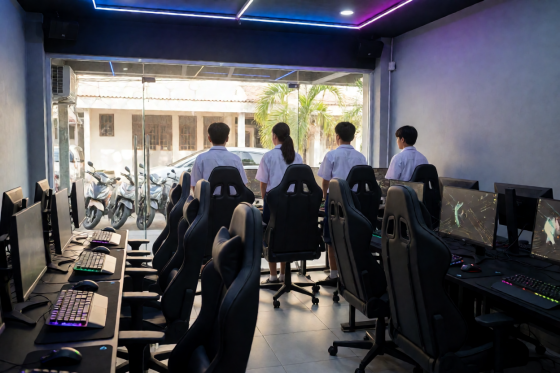
Two o'clock on a Wednesday afternoon, three boys in school uniform are waiting outside a 36-seat e-cafe on a soi behind Ramkhamhaeng University. They have been there since ten to two. The attendant looks at the clock on the wall, then at the boys, then at the clock again. Nobody opens the door early.
Anyone who runs an e-cafe in Thailand knows that scene, because the working day is not really one day. It is three clocks running at once. There is the one the Culture Ministry set, which decides who can sit down and for how long. There is the school calendar, which empties the floor in term time and fills it from ten in the morning during the breaks. And there is the clock of the squad, the five friends who walk in at seven on a Friday night and want five seats in a row, right now, with the same screens and the same mice, because that is how they practise. This piece is about running all three without the attendant keeping them in her head.
What an e-cafe sells now that everyone has a phone
Ten or twelve years ago Bangkok had a net shop on every other soi, charging somewhere between half a baht and two baht a minute. Most of those are gone. Phones took the browsing first. Then phones took a big share of the gaming too, since RoV, Free Fire and Mobile Legends are the backbone of Thai esports and nobody pays for a desk to play them.
What survived is the e-cafe. The shops that made it through turned into something a phone cannot copy: a 240Hz screen, a proper mouse, air conditioning in April and four friends within shouting distance. Valorant is the engine. It was named the most popular ongoing PC game at the Thailand Social AIS Gaming Awards in 2026, the second year running, and Bangkok hosted Valorant Masters in 2025. FC Online is the other big one, helped along by its place at the SEA Games Thailand hosted last December. CS2 and Dota 2 keep a loyal older crowd.
So the modern e-cafe sells a short list of things. Seat hours, priced by the quality of the seat. Time packages, bought before the customer sits down. The row, meaning five machines side by side for a team that plays together. Food and drink ride on top of all of it. The few paid titles on the floor sit in a shared licence pool, so a copy goes to whoever is playing it at that moment and comes back when they finish.
Each of those runs on a different clock, and that is where a counter with a notebook stops coping. Cafe management software built for exactly this kind of floor puts the seats, the packages and the members on one screen and lets the clock do the watching. iCafeCloud runs venues in more than 90 countries, but the Thai version of the problem is unusually specific, so the rest of this article stays specific.
Students in school uniform inside a Bangkok e-cafe with rows of gaming seats on a weekday afternoon
The clock the Culture Ministry set for every e-cafe
The rules most Thai owners work to come from the 2009 ministerial regulation on video game shops, and they are short enough to fit on a card:
- Under 15: weekdays from 14:00 to 20:00. On public holidays and school breaks, from 10:00 to 20:00.
- Aged 15 to 18: weekdays from 14:00 to 22:00. On holidays and school breaks, from 10:00 to 22:00.
- Anyone under 18: no more than three hours of play in a day.
- 18 and over: any hour, which is why the 24-hour e-cafe exists at all.
A Game Industry Act has been in draft at the Digital Economy Ministry this year. For now, the card above is the one pinned behind most counters.
Look at what that does to the floor. At 13:59 the only people allowed in are adults, which in a university neighbourhood means students with a free afternoon. At 14:00 the school crowd arrives. At 20:00 the under-15s leave, at 22:00 the under-18s, and the room goes back to adults until morning. Three groups of customers, three different closing times, and a three-hour limit on top that starts whenever each kid sat down.
At most e-cafe counters the attendant handles this with a glance at an ID card and a glance at the clock. That works with six kids on the floor. It stops working at 16:30 on the first day of a school break, with twenty-two of them spread across 36 seats and a queue at the counter.
The fix is to stop selling under-18s open time. Sell them a package instead. In the Time and offer screen of iCafeCloud, every offer is a block of time at a price, and each one sits on a weekly grid against a PC group and a member group. You decide which customers can buy it and in which hours. A three-hour offer that only exists for your under-18 group, and only from 14:00 on weekdays, turns the card behind the counter into a setting instead of a memory. When the three hours are used up, the machine locks by itself, and nobody has to walk across the room to tell a fourteen-year-old his time is over. (Set one up on the live demo before you touch your own floor. It takes a few minutes.)
iCafeCloud Time and offer screen with time packages scheduled by day and hour for each PC group and member group
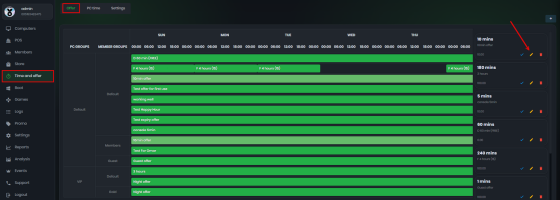
That is the offer grid. Rows are PC groups and member groups, columns are days and hours, and each green bar is an offer on sale in that window. The cards on the right are the packages themselves, a 180-minute offer next to a 240-minute one, each with its own price.
Registration is where this gets won or lost. Take the date of birth from the ID card when the member signs up and put the account in the right group then, once, on a quiet Tuesday. After that the group does the remembering.
Two rates on one floor, and who sits where
Bangkok e-cafe prices have a clear shape once you look at enough of them. Standard seats around MBK are quoted at 30 to 50 baht an hour. Higher-spec rooms, like AIS eSports Studio at Samyan, are quoted at 60 to 80. Day passes at the lounge end of the market run from 250 to 500 baht. Outside Bangkok, 15 or 20 baht an hour is still a commonly seen number on the sign, and in a university town it still fills seats.
Most e-cafe owners end up with two tiers on one floor, standard seats and a VIP section with the faster screens and better chairs. The mistake is running both from one price list and a spoken "VIP is extra". Put the VIP machines in their own PC group with their own offers, and the price follows the seat instead of the attendant's memory.
Member groups do the other half. The list below is the structure: General at zero, then tiers that each need a minimum number of points, so a regular moves up a level on their own as the points build. Discounts hang off the group and apply automatically, based on how much a customer has topped up or how many hours they have logged. You set the thresholds once and leave them alone.
iCafeCloud member groups list showing tier names, minimum points and icons
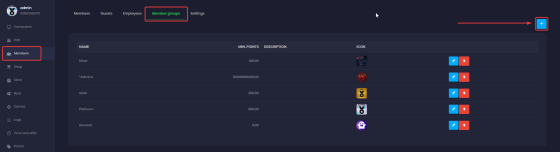
Give university students a group of their own as well. A student card from Ramkhamhaeng or Rangsit is about the most reliable sign you will get of someone who comes back four afternoons a week, and a student rate costs an e-cafe far less than an empty seat at three o'clock.
Is the five-seat row your real product?
Valorant is played five a side. So is a lot of CS2. The customer who walks in at 19:00 on a Friday is not one person, it is a squad, and the squad wants five seats together, not two by the window and three by the toilet.
Most e-cafes leave this to luck. If a row happens to be free, fine. The better ones sell it. Pick a row near the back where the noise bothers nobody, put those five machines in their own PC group, and give the group its own offers: a squad hour, a three-hour squad block, a Friday night price. When the team arrives, the attendant starts all five sessions from the admin panel without leaving the counter, and one of them pays. In practice the row becomes the most reliably sold set of seats in the room, because a team that played there last Friday comes back and asks for "our row".
Two habits make it stick.
Keep the five machines identical (same screen, same mouse, same settings, down to the sensitivity), so nobody argues about who got the bad seat. And do not break the row up for walk-ins after 18:00 on Fridays and Saturdays, even when it is still empty at 18:10. A squad that finds its row gone does not come back next week.
Mama, iced tea and the second till
Honestly, instant noodles and iced tea earn more per square metre than any seat in the e-cafe. They also leak the most, because they get sold in a rush, often in cash, by the same person who is starting sessions.
Ring every cup through the POS on the same screen as the machines. It takes the same two seconds as opening a cash drawer, and the shift report then shows the mama next to the hours instead of in a notebook somebody forgets to total.
School break flips the e-cafe floor
Thai school breaks turn the card behind the counter upside down. From mid-March to mid-May, and again in the shorter October break that starts in a couple of weeks, under-18s can come in from 10:00. An e-cafe that was a quiet room of adults until two in the afternoon is full at half past ten. Songkran is its own animal (a slow afternoon and a very busy night). Half the regulars go home to the provinces, and the other half spend the afternoon on the street with water guns and turn up at 18:00 soaked.
Plan the break from your own e-cafe's numbers last year, not from your memory of them. Pull the hourly report for the last week of term and the first week of the break and put them side by side. The shape of the day changes completely, and the rota should change with it: a second attendant from 10:00 to 16:00 during the break, not in the evenings when the floor is mostly adults who need very little looking after.
The week before a break is also when you clean house. The annoying part is that kids install things. After a month of holidays every PC has a toolbar, a strange launcher or a wallpaper nobody chose. If the floor boots diskless with CCBoot, one clean image on the server and a reboot put every machine back the way you built it, every morning if you like. The bundle with iCafeCloud is priced for exactly this kind of e-cafe.
PromptPay, cash and the number at the end of the shift
Most customers now top up with a PromptPay scan at the e-cafe counter. Some still hand over cash, especially the younger ones. Both are fine, as long as the attendant records the payment method with the top-up, which is one tap.
Then the handover is short. Cash in the drawer, the PromptPay total on the shop's banking app, and the iCafeCloud shift report with earnings and expenses on one side and member activity on the other. If the numbers match, the next person signs and starts. If they do not, you look now, while whoever took the money is still in the room.
What the software costs in baht
Prices are in US dollars on the per-PC price list. At this week's rate of about 33.5 baht to the dollar, it works out like this.
iCafeCloud monthly is 2.50 dollars per PC, about 84 baht. Annual is 2.00 dollars, about 67 baht. A 36-seat e-cafe pays roughly 3,000 baht a month, or about 2,400 on the annual plan. Now put that next to the fibre bill, where True quotes 899 baht a month for 1000/500 Mbps and AIS quotes 1,099, both before VAT. Bandwidth is cheap in Thailand. Seats, hours and people are what cost money, and those are exactly what the software watches. The bundle with CCBoot is 4.00 dollars per PC monthly, about 134 baht, or 3.20 dollars on the annual plan, about 107.
Trials start at ten machines and run for fifteen days, extendable to thirty. Install the server, apply for a trial licence from inside the software, and the key arrives over WhatsApp or Telegram. Support is in English, around the clock.
Then think about those three boys at the door again. Next Wednesday at 14:00 it could go like this: the door opens, each of them logs into an account that already sits in the under-18 group, a three-hour offer is the only one that group can buy, and at 17:00 the screens lock without anyone crossing the room. The attendant spends the afternoon selling iced tea and keeping the back row free for the Friday squad. That is a well-run e-cafe in Thailand. The clocks still run. They just stop running through one person's head.