

Four o'clock on a Saturday afternoon in August, and it is 43 degrees outside Dubai Hills Mall. Inside, a 48-seat cyber lounge on the ground floor is full. Two brothers on holiday from Riyadh are playing EA FC side by side. A receptionist from the clinic upstairs is spending her break on Valorant. A mother has left her two sons in the PlayStation corner and gone to finish the shopping. Across town in Al Barsha, and over the water in Doha, lounges that look nothing like this one are filling up with the same kinds of people.
Only some of them will ever come back. Running a cyber lounge in the UAE or Qatar is mostly the work of knowing which ones, and making it easy for them to return. The brothers fly home on Thursday. The receptionist works upstairs five days a week, lives twenty minutes away in Al Barsha, and would happily spend her lunch hour at the same seat every Tuesday if anyone gave her a reason to.
Why "lounge" is the right word in the Gulf
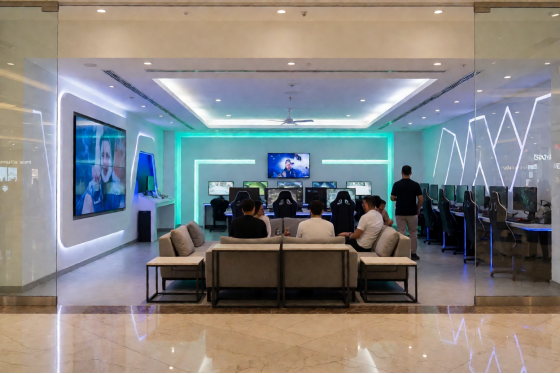
Gulf gaming venues rarely look like the dark rows of a classic internet cafe. They look like lounges: a sofa area at the front, a coffee bar with karak on the go, clean lighting and a glass frontage onto a mall corridor. Customers expect to be looked after, the way they would be in a cafe. They notice when they are not.
Prices cover a wide spread. In Dubai, a community venue in Al Barsha lists standard seats from AED 10 an hour, while a mall chain such as True Gamers, with 14 clubs across the UAE, charges around AED 25 for a standard seat and AED 45 for a VIP suite. In Doha, published rates run from QR 15 an hour at PVP Zone to QR 20 at Qzone and QR 25 at Legion, with VIP PCs at QR 35, and Virtuocity has more than 200 stations under one roof. EA FC is the anchor title on both PC and PlayStation. Around it you will find CS2, Valorant, Fortnite, Call of Duty and PUBG.
Those numbers hide a more useful split. Some lounges sit in malls, where most of the people walking in are visitors or families out shopping, people who may never pass that way again. Others sit in neighbourhoods like Al Barsha, Muwaileh in Sharjah or the residential districts of Doha, where most customers live ten minutes away and come back every week. The first kind lives on guests. The second lives on members. Most lounges are a mix of both, and the ones that do well treat them as two different customers with two different price lists.
That is how cafe management software that treats guests and members as two different customers is built. iCafeCloud keeps them apart from the first screen, and the rest of this article follows that split through a Gulf cyber lounge's year.
A cyber lounge inside a Dubai mall with a sofa area at the front and gaming PCs behind
Two businesses under one roof: guests and members
A guest walks in, pays and plays. Then they leave. A member has an account with a name on it, a balance, a group and a history. The same hour at the same seat can be worth very different amounts depending on which of the two sits down.
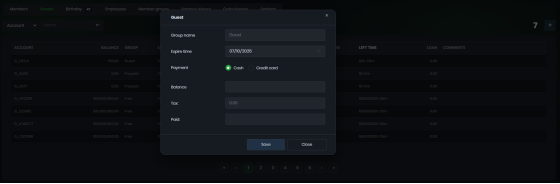
In the iCafeCloud admin, guests have their own tab next to Members. Each guest gets an account code of its own, a group (Guest, Prepaid or Free in the screenshot below), a balance and the time left. The top-up form records whether the guest paid cash or by card, and it has a Tax field, which saves a separate calculation in the UAE, where VAT is 5 percent. A guest account can also carry an expiry date. For a visitor who buys a block of time on the first day of a trip, the balance simply ends with the holiday.
iCafeCloud Guests tab with the guest top-up form showing group, expiry date, payment method, balance and tax
The more important part is pricing. Guests and members should not see the same offers. In the Time and offer screen, Guest is a group of its own, and each offer can be switched on for guests, for members or for both, at the hours you choose. A mall cyber lounge usually sells guests simple blocks at a fair walk-in rate: one hour, two hours, three. Members get the better per-hour price, and the gap between the two is the whole reason to become one.
Honestly, this is the single setting most new lounges get wrong. They open with one price list for everyone, and then wonder why nobody bothers to register.
Then read the day report with that split in mind. If guests bring in most of the money and almost none of them come back, the lounge is running like a tourist attraction. There is nothing wrong with that in Dubai Mall. In a residential area of Doha, it usually means the counter is letting too many regulars walk out without an account.
The moment a guest becomes a member
Most lounges ask the wrong question at the wrong time. Timing is everything here. "Do you want to register?" at the door, to someone who just wants to sit down, gets a no almost every time.
The better moment comes about an hour later. The guest's time is nearly up, the match is going well, and they walk back to the counter to buy more. That is when the attendant says it: open an account now and the next hour is at the member price. It takes a name and a phone number at the counter, less than a minute, and the customer saves money on the spot. Very few people say no to that. In practice the conversion rate at that moment is far higher than anything a sign at the door will ever get.
Two habits make it work in a Gulf cyber lounge.
First, ask where they live before you offer anything. A family in Dubai for five days does not need a membership, and pushing one makes the counter feel like a sales desk. A resident of Jumeirah Village Circle or Al Sadd is a different matter, and a simple "Do you live in Dubai?" sorts the two without any awkwardness.
Second, make the member price visible. Put it on the screen above the counter next to the guest price, in dirhams or riyals, so the customer can do the maths without being told. (You can look at how offers and groups are set up on the live demo before you print anything.)
What keeps a member in a Doha cyber lounge?
Getting someone to open an account is the easy half. Keeping them is not. Retention is where a neighbourhood cyber lounge earns its rent, because the same thirty or forty regulars, week after week, are what pay the landlord in a residential block in Doha long after the novelty of a new venue has worn off for everyone else.
Member groups carry most of the weight. Each group has a minimum points threshold, so a regular moves up from the entry level to Silver and then Gold on their own as they play. Discounts can also kick in automatically based on how much a member has topped up or how many hours they have logged. You set the thresholds once, and after that no attendant has to decide who deserves a better rate.
Birthdays matter more in the Gulf than most owners expect. Groups of friends book a night for someone's birthday, and a free hour for the person celebrating usually brings four paying friends with them. The member section in iCafeCloud keeps its own Birthday tab next to Members and Guests, so the list is already there when you plan the week's birthday hours.
Top-ups are the third lever. A member who has put AED 200 or QR 200 on their account has already decided where they will play next weekend. Offer a small bonus on larger top-ups, keep it the same every week, and the balance does the rest.
Weekends are not the same across the two markets. Member promotions should follow them. The UAE weekend is Saturday and Sunday. Qatar's is Friday and Saturday. A chain with branches in both runs two different Thursday nights, not one.
The PS5 corner and the parents who leave for an hour
Mall lounges have a customer the neighbourhood venue rarely sees: the parent who leaves the children at the PlayStation area and goes shopping. They want one thing, to know exactly when the time ends.
Sell it as a fixed block. One hour of console time, paid as a guest at the counter, and when the hour runs out the console cuts off on its own. Nobody has to find the parent in the food court. And the children are not left playing on time that nobody paid for. Console time is billed and controlled from the same admin panel as the PCs, so the PlayStation takings sit in the same day report as everything else.
It is worth keeping a short 30-minute console offer in the cyber lounge as well. Parents who are only going to the pharmacy downstairs buy it more often than you would think.
Summer afternoons, Ramadan nights, Eid week
A Gulf cyber lounge has three peaks a year, and none of them looks like the others.
Summer comes first. From June into September the heat pushes people indoors in the middle of the day, and anyone who has tried to walk from a car park to a mall entrance in Doha at two in the afternoon in August understands exactly why the lounge fills up the moment the doors open. With 43 degrees outside, a mall is the only place most families want to be at three in the afternoon, and school holidays fill the lounge from late morning. Offers for this season should start earlier in the day than the rest of the year.
Ramadan moves the whole day into the night. The National once described gaming cafes as busiest from about 8 pm to 4 am during the holy month, and some venues open around the clock. Ramadan 2027 is expected to begin on or around 8 February. The time to prepare is the week before, not the first night. Put the Ramadan offers into the Time and offer schedule so they only go on sale after iftar, move the staff rota to match, and update every machine before the rush starts. If the floor boots diskless with CCBoot, that update happens once on the server image and every PC picks it up at the next reboot, which is a lot easier than doing 48 machines by hand at 2 am.
Eid is the shortest peak and the busiest. Plan for it. Families are off work, children have money from relatives, and the lounge can be full from opening to close for three or four days in a row.
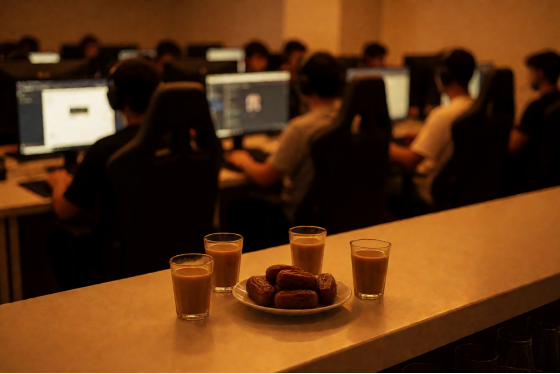
A Doha gaming lounge after midnight with karak tea and dates on the counter
Chains, branches and one owner
Gulf lounges grow into chains quickly. One brand in the UAE already runs 14 clubs, and plenty of smaller owners have two or three branches spread between Dubai and Sharjah, or across Doha.
The venue selector at the top of the iCafeCloud admin lets an owner move between branches from one login. That sounds small. It is not, when the alternative is phoning each cyber lounge at midnight and asking the attendant to read out the till. At the end of a busy Friday in Doha or Saturday in Dubai, the owner can check each branch's day, in turn, without driving between them.
What the software costs in dirhams and riyals
The prices on the per-PC price list are in US dollars, and here that is good news. The dirham and the riyal are both pegged to the dollar, at 3.6725 and 3.64, so the cost in local currency does not move.
iCafeCloud is 2.50 dollars per PC per month, which is AED 9.18 or QR 9.10. On the annual plan it drops to 2.00 dollars, AED 7.35 or QR 7.28. For a 48-seat cyber lounge that is about AED 441 a month in Dubai, or AED 353 on the annual plan, and about QR 437 a month in Doha. The bundle with CCBoot is 4.00 dollars per PC monthly, AED 14.69 or QR 14.56, and 3.20 dollars on the annual plan.
Trials start at ten machines and run for fifteen days, extendable to thirty. Install the server, apply for a trial licence from inside the software, and the licence arrives over WhatsApp or Telegram. Support runs around the clock for more than 3,000 clients in over 90 countries, and the Arabic version of the site is there for partners and staff who would rather read it in Arabic.
Back at Dubai Hills Mall, the mother comes back with her shopping at five past five. The console hour ended at four minutes to five, her sons are waiting by the counter, and the attendant is asking the two brothers from Riyadh whether they would like one more game. They are only in town for a week, so he does not offer them a membership. The receptionist from upstairs, on the other hand, opened an account at ten to five, when she came back to the counter for another half hour. That is a cyber lounge doing its job: every guest looked after, and the right ones turned into members.