

Turkey once had about 27,000 internet cafes. In 2024 the head of the Istanbul chamber that represents the trade put the remaining number near 5,000. Greece publishes no national count at all, although the shop sign that visitors know as the internet point is still easy to find near ports and old-town squares in both countries.
This report sets the two markets side by side because they share a pattern: near-universal home access, very large visitor numbers, and an internet point trade that became smaller without disappearing. Two limits apply to the data. The Turkish venue count is a trade body estimate that is now two years old, and the Greek figures have gaps, which are marked as gaps.
Two countries in figures
The table collects the public figures that bear on the trade. Each cell names its source and year, because the numbers come from different bodies and are not strictly comparable.
Indicator | Greece | Turkey |
Home internet | 88.7% of households | 92.3% of people aged 16 |
Visitors per year | About 37.9 million | About 63.9 million visitors |
Venue count | No public national figure | About 27,000 at the peak, |
Hourly rate at newer | About 2 to 4 euros (trade | Revised several times a |
Home access is close to universal. In Greece, ELSTAT reported that 88.7 percent of households had an internet connection in 2025, a rise of 23.1 percentage points since 2014. TÜİK measures individuals, not households, and found that 92.3 percent of people in Turkey aged 16 to 74 were online in 2026, against 90.9 percent a year earlier. A business that sold access and nothing else has lost its market in both countries.
Both countries also receive visitors in very large numbers. Greece recorded about 37.9 million international arrivals in 2025, more than three times its resident population. Turkey reported about 63.9 million visitors in the same year. Some of those travellers will need a screen, a printer or a charged device at some point in the trip, and they will need it within walking distance. That is the demand an internet point beside a port exists to meet.
The venue count is the weakest row in the table. The Turkish number comes from İlhan Taşkıran, head of the Istanbul chamber of internet cafe operators, who told the newspaper Hürriyet in 2024 that the national total had fallen from about 27,000 to about 5,000. He added that 360 venues had closed in the preceding three months and that six had opened. This is an estimate from a trade body, and no later figure has been published.
Greece has no such count. Greek business directories list the category under ίντερνετ καφέ, and several Greek chains have kept their stores open and continued to invest in them, but no public source adds the outlets up. The Greek cell is left empty for that reason.
Why the access trade thinned out
The causes are not in dispute. Households connected, as the first row of the table shows. Smartphones then put a browser in every pocket, which removed the casual customer who came into an internet point to read mail for ten minutes.
The cost was the rest in Turkey. Mr Taşkıran told Hürriyet that the investment needed for one customer PC had risen from about 15,000 lira to about 80,000 lira. An operator who cannot refresh hardware loses the gaming customer, and the gaming customer is the one who stays for hours. Rooms with older machines and thin margins closed first.
Neither factor has reversed. The venues that remain have adjusted to both.
Who still walks into an internet point
The common summary of this market is that it died. The closure figures support a narrower claim, which is that the trade concentrated. Demand did not fall to zero. It fell to the customers who still had a reason to pay for a seat, and it moved to the venues able to serve them. Those customers divide into three groups.
Customer group | What they buy | When they come | What the venue |
Passing trade: | 20 to 60 minutes | Daytime, with a | Prepaid short |
Local regulars: | Two to five hours | Evenings and | Member accounts, |
Groups: friends on | A console station | Evenings, | Consoles billed on |
Passing trade
This is the group that gave the internet point its English name. The sign is written for people who do not read Greek or Turkish, and it appears where they walk: ferry ports, bus stations, old-town streets and seafront strips. These customers do not come back, so nothing is gained by registering them. They want to pay, sit down, finish and leave.
Street-front internet and gaming venue in a Mediterranean port town at dusk
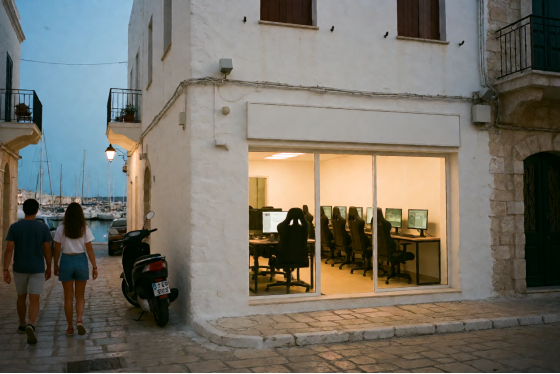
Their value per visit is low. Their value to the venue lies in volume and in timing, because they fill daytime hours when the regulars are at school or at work. In a resort town the passing trade can carry the summer months almost alone, and then it stops in October.
Local regulars
Regulars are the base of the business in every month of the year. A capable gaming PC costs more than many households in either country will spend, and the Turkish cost figures quoted above apply to families as much as to operators. A venue with current hardware therefore sells something the home does not have.
Regulars compare prices and they compare venues. They also form habits, and tend to choose one room, one row and often one seat. Accounts and prepaid balances exist for this group, as do tiered discounts. University towns show the pattern most clearly, with demand that follows the academic calendar and takes no notice of the tourist one.
Groups
Groups are the smallest segment by headcount and the most visible on a weekend evening. Football titles on a console draw pairs and fours in both countries. Small teams take a row of PCs for a session of Valorant or Counter-Strike 2. A group spends more per visit than a customer from either of the other segments, and it tends to bring new regulars with it.
The mix differs by location. A venue two streets from a ferry terminal may take most of its summer revenue from passing trade and most of its winter revenue from regulars, while a venue beside a university may see almost no tourists at all. What the three groups share is that none of them is paying for internet access. They are paying for a place, a machine and a period of time.
What the remaining venues sell
The product has changed from access to equipment and time. Four things now account for most of what an internet point in this market sells.
Diagram linking three customer groups to what an internet venue sells
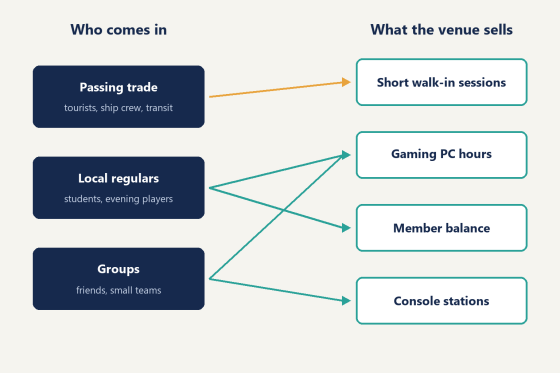
The largest is the gaming PC seat, sold by the hour or drawn down from a prepaid balance. In Greece the titles in demand are League of Legends, Counter-Strike 2 and Valorant, with EA Sports FC strong on both PC and console. In Turkey the list is led by Valorant and Counter-Strike 2, followed by PUBG and the locally developed shooter Zula. The Greek trade press puts the hourly rate at newer venues at about 2 to 4 euros in 2026. That figure is not official, and it varies by town.
The console station comes next. It takes little floor space and suits the football audience that both countries share. Operators treat it as a seat like any other, with a timer and a price, and it closes when the paid time runs out.
The member relationship is the least visible of the four. A regular who has loaded money onto an account has already decided where next week's hours will be spent, which is why the prepaid balance matters more to a venue's stability than the headline hourly rate. The point carries extra weight in Turkey, where operators revise prices several times a year as their costs move. A lira rate printed in this report would be out of date within months, so none is given. What can be said is that a venue holding customer balances changes its tariff in one place and applies it from the next session.
Short walk-in sessions complete the list, and they matter mainly in tourist locations. They earn less per seat-hour than gaming does. They also use hours that would otherwise be empty.
A Turkish oyun salonu and a Greek net cafe run the same mixed operation under different names, and running it by hand is where the older model broke down. This is the point at which management software such as iCafeCloud becomes part of the business.
How the remaining operators run the floor
An internet point that serves three customer groups on two kinds of hardware has four administrative tasks. The operators still trading have, for the most part, moved each of them from paper to software. The description below follows the published feature list of iCafeCloud, a management system with more than 3,000 client venues in over 90 countries.
Accounts and billing
Every regular has an account. The clock starts at login and stops when the session ends, and the charge is calculated without staff involvement. Discounts apply automatically once a customer has topped up a set amount or logged a set number of hours, with the thresholds chosen by the operator. For the regular segment, this replaces the notebook and the informal "tenth hour free" arrangement with a rule that works the same way on every shift.
Control of the machines
Staff can start a session, end it, restart a PC or cut off access from the admin panel without leaving the desk. When paid time runs out, the machine locks. Consoles are covered by the same billing and time control as PCs. This is the function that makes the passing trade workable for an internet point with one person on duty: a prepaid thirty-minute session ends when it should, and nobody has to watch the clock or ask a customer to leave.
Game licences and updates
Buying a copy of every paid title for every machine is expensive. A shared licence pool assigns a licence when a customer launches a game and returns it when the session ends, so the number of licences follows the number of people playing at once.
Updates are a related cost, since a dozen PCs downloading the same large patch will fill a small commercial line for an evening. Venues that also run CCBoot, the diskless boot system from the same company, update one image on the server and the client PCs pick it up at the next restart.
Reporting
A daily report sets out earnings and expenses alongside member activity. In a market with two distinct seasons, this is the document that shows which customer group carried the month, and so which tariff or which opening hours to change.
Licensing is per client PC, on monthly or annual terms, and the supplier publishes its current per-PC pricing online. An operator who prefers to judge the system against a real fortnight of trade can apply for a trial license covering ten or more PCs for 15 days, extendable to 30 on request. Support runs around the clock.
The next two years
Three developments appear likely. They are judgments drawn from the figures above, not the output of a model.
The number of venues will probably keep falling slowly while the average venue grows. Hardware costs favour operators who can refresh twenty or forty machines at a time, and the Turkish closure data already shows rooms closing far faster than new ones open.
The passing trade will hold where visitors concentrate. Arrivals in both countries set records in 2025, and a traveller with a dead phone or a boarding document to print is not helped by household broadband statistics.
Venues that manage accounts, machines and licences through software will be over-represented among those still open in 2028. The reason is arithmetic. A room serving three customer groups, on PCs and consoles, across two seasons, produces more administrative work than one person at a desk can do by hand.
The internet point will not return to the numbers of fifteen years ago. In Greece and Turkey it has become a smaller trade with a clearer purpose, and the shops still carrying the sign are the ones that worked out which customers were left.