

It is 23:40 on a Friday in Section 7, Shah Alam, and the 44-seat e-cafe on the ground floor of the shoplot is still three-quarters full. Anyone walking past to the mamak next door can see every screen through the clear glass front: the Valorant lobby on seat 12, the Dota 2 draft on seat 31, the attendant behind the counter starting to count down the last sessions of the night. Nothing in the room is hidden, and in Malaysia that is not a design choice. It is a licence condition.
This article is about running an e-cafe in Malaysia inside that glass box. The rules that shape the floor, the two price levels the market has split into, the last hour before midnight, and the part of the business the pavement cannot see, which is the books.
Why Malaysian owners stopped saying cyber cafe
Fifteen years ago every row of shoplots in the Klang Valley had a cyber cafe. Some of them ran Counter-Strike and Warcraft III until closing. Some of them ran something else entirely behind tinted glass, and after enough raids on illegal gaming machines the phrase "cyber cafe" picked up a reputation that honest owners have been paying for ever since.
So the new shops call themselves something else. E-cafe. Esports cafe. PC bang, since a Korean-style shop billed as the country's first opened in Kota Damansara in 2025. The name change is partly marketing, but mostly it is a way of saying to parents, landlords and the local council that this is a different kind of business.
The games changed too. Valorant has the most committed PC cafe crowd in Malaysia right now. Dota 2 is the old guard, and it still carries weight: roughly 62 percent of all the esports prize money Malaysian players have ever won came from Dota 2. Mobile Legends and PUBG Mobile have the biggest player bases of all, but those live on phones, and nobody rents a desk to play them. What an e-cafe sells is the PC side: a fast screen, a proper chair, air conditioning, and friends in the next seat.
The glass front lets the pavement see the floor. What the owner needs is the same kind of view of everything else: who is on which seat, what they paid, what they ate, and whether the drawer matches at the end of the night. That is the job of cafe management software that keeps the books as open as the shopfront, and the rest of this piece is about how that works in a Malaysian e-cafe specifically.
A Malaysian e-cafe seen at night through its clear glass shopfront, with an open floor of gaming seats
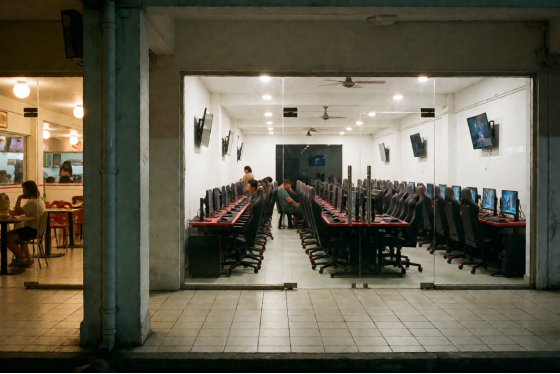
The rules you can read from the pavement
Cyber cafe licences in Malaysia come from the local council, the PBT, and the conditions differ from one council to the next. Shah Alam's conditions give a good picture of what a Klang Valley e-cafe is working with:
- Opening hours from 07:00 to 12 midnight.
- The door and front wall in clear glass or another transparent material, not tinted and not covered.
- An open floor with the computers in plain view: no rooms, no doors, no partitions.
- No students in school uniform on the premises.
- Children under 12 only until 22:00, and only with a parent or guardian.
- At least 40 computers, with floor space of 0.8 by 1.5 metres for each one.
Kuala Lumpur added its own layer in 2017, when the Federal Territories Ministry said cyber cafes could only operate on ground floors or inside shopping malls, with no two-storey outlets and no dark glass. Every one of those rules comes from the same worry, that a room full of computers behind closed doors turns into something other than a gaming venue.
Your own council's licence conditions are the ones that count, so read them line by line before you sign the tenancy. The practical point for this article is simpler. Most of the rules are about what people can see, and they shape almost every decision further down. An e-cafe that is planned around them from the first day, with the counter facing the door, the rows running back from the glass so the whole floor reads clearly from the pavement, and the premium block placed where it catches the eye of everyone who walks past, rarely has to move a single desk later. Plan it once. Build it once.
No rooms allowed, so the tiers live in the hardware
In Seoul or Bangkok, a gaming venue charges more for a VIP room with a door. In Shah Alam there is no room to charge for. The whole floor is open and in view, so a Malaysian e-cafe has to put its price tiers somewhere else, and the only place left is the machines.
That turns out to work well for an e-cafe. Put the fastest screens, the best chairs and the newest cards in one block, give that block its own name, and price it as its own group. In iCafeCloud every PC group carries its own offers and its own hourly rate, so the attendant does not quote prices from memory. The customer who sits at seat 3 pays the seat-3 price because seat 3 belongs to that group.
iCafeCloud floor layout showing machines grouped by zone with each seat's remaining time
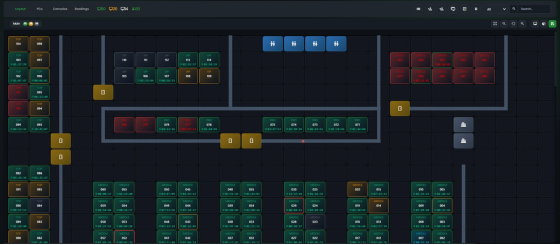
The screenshot is the Layout view. Each tile is a machine placed where it actually stands on the floor, labelled with its zone (TOP, VIP, PRO, MIDDLE, SPACE in this example), and every occupied seat shows how much time is left. On a Malaysian open floor this screen looks a lot like the room itself, which is the point. The attendant can see at a glance which zone is filling up and which one is sitting empty at 16:00.
Here is one habit worth copying. Put the premium block where it is most visible from the glass door. With no VIP room to hide it in, that row of fast screens is your signboard, and the person walking to the mamak at 21:00 sees it before they see anything else. (Open the Layout view on the live demo to see how a floor map reads before you plan your own.)
RM2 or RM5.50: which e-cafe are you running?
Prices in the Klang Valley have split into two levels, and they are far apart.
At one end sits the neighbourhood cyber that has been in the same shoplot for a decade. Some of these advertise member rates as low as RM2 an hour. The machines are fine, the regulars have been coming since secondary school and now bring their own younger cousins, and the whole business runs on volume and habit, which is a perfectly good way to run an e-cafe as long as the owner knows that is the model. It works. At the other end sit the new Korean-style PC bangs, which start at around RM5 to RM5.50 an hour and sell the experience: new chairs, new screens, kimchi fried rice brought to the seat.
To be fair, neither level is wrong. The mistake is running a RM2 e-cafe with RM5 costs, or a RM5 e-cafe with a RM2 feel, and not knowing which one you are until the rent is due.
At the RM2 end, the game is keeping regulars. Member groups do most of that work. Each group has a minimum points threshold, so a regular climbs from General to Silver to Gold on their own as they play, and the discount comes with the group. Discounts can also kick in automatically from how much a customer has topped up or how many hours they have logged. You set the thresholds once. After that nobody at the counter decides who gets a deal and who does not, which matters more than it sounds in a shop where half the customers know the attendant from school.
At the RM5 end, the game is filling the premium block and the kitchen at the same time. Price the premium PC group well above the rest, and let the food carry some of the margin.
Most e-cafes in Malaysia end up somewhere between the two. The Layout view and the daily report tell you where you really sit, because they show which zones earn and which zones wait.
The last hour before midnight
Shah Alam's licence conditions stop trading at 12 midnight. For a Malaysian e-cafe that makes 23:00 to 23:59 the most awkward hour of the day. The room is still busy, new customers are still walking in after dinner, and at some point somebody has to tell a player in the middle of a ranked match that the night is over.
The worst way to handle it is at 23:58, by hand. The better way is to stop selling time that runs past midnight in the first place.
In iCafeCloud's offer schedule, each package only goes on sale in the hours you choose. So stop selling the one-hour package at 22:59. From 23:00 the only offers on sale are short ones, a 30-minute and a 45-minute, and after 23:30 only the 30. Anyone who walks in at 23:10 gets time that runs out before midnight, and when it runs out the machine locks by itself. The attendant spends the last half hour cleaning desks instead of tapping people on the shoulder.
Honestly, this one setting removes more arguments than any sign on the wall.
One more detail from e-cafe counters that do this well. Name the last offers after the closing time, "Until midnight, 30 min" rather than just "30 min", so the attendant and the customer are reading the same words when the money changes hands at 23:25. Small things. Fewer complaints.
Kimchi fried rice to seat 14
The PC bang wave brought food onto the floor properly. Ramen, fried rice, toast, iced drinks, carried to the seat. At RM5 an hour, the food is often where a Malaysian e-cafe actually makes its margin.
It is also where the money leaks, because it gets sold in a rush by the same person who is starting sessions. Ring every order through the POS on the same screen as the machines. The daily report then shows the fried rice next to the hours, instead of in a notebook somebody forgets to total.
One QR, every wallet, and the count at close
Malaysia pays by phone more than almost anywhere in the region. One DuitNow QR code on the counter takes payment from any Malaysian bank app or e-wallet, and there are around 2.6 million of those QR acceptance points nationwide. Touch 'n Go eWallet alone has more than 23 million verified users. Cash has not disappeared, especially with the younger customers, but it is no longer most of the drawer.
In practice that creates one small discipline for the e-cafe counter. When a customer tops up, the attendant records how they paid: cash, DuitNow or Touch 'n Go. It is one tap. Without it, the report at close shows one total, and nobody can match it against the wallet statement.
At midnight the count is three numbers. Cash in the drawer. The e-wallet and bank transfers on the shop's phone. And the iCafeCloud report, with earnings and expenses on one side and member activity on the other. If they match, the attendant signs off and goes home. If they do not, you check now, not at the end of the month. That is what a clean set of books looks like, and it is the part of the business the glass front cannot show anyone.
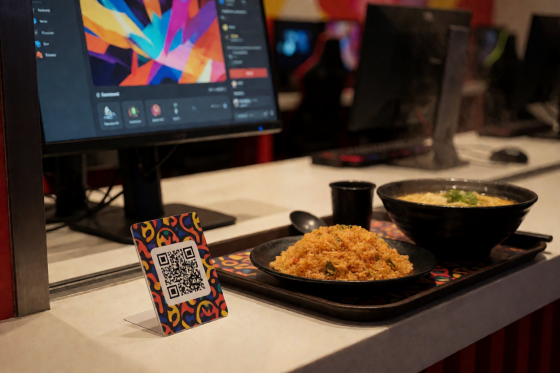
Counter of a Klang Valley gaming cafe with a payment QR stand and a bowl of ramen waiting to go out
Forty machines and one image
Shah Alam asks for at least 40 computers. For a new e-cafe that is a real number. Forty machines that each need the same Valorant patch, the same Dota 2 update and the same Windows update is a lot of walking between desks.
Two things take that walking away. Paid titles sit in a shared licence pool, so a copy goes to whoever is playing at that moment and returns when they finish. And if the floor boots diskless with CCBoot, the update happens once on the server image, and all forty machines pick it up at the next reboot. The bundle with iCafeCloud is built for exactly that kind of e-cafe.
What the software costs in ringgit
The prices are in US dollars on the per-PC price list. At Bank Negara's reference rate of about 4.08 ringgit to the dollar this week:
iCafeCloud is 2.50 dollars per PC per month, about RM10.20. On the annual plan it is 2.00 dollars, about RM8.16. For a 44-seat e-cafe that comes to roughly RM449 a month, or about RM359 on the annual plan. For comparison, TIME's 1 Gbps business fiber is RM199 a month and Unifi Business 1 Gbps is RM319. The bundle with CCBoot is 4.00 dollars per PC monthly, about RM16.30, or 3.20 dollars annually, about RM13.10.
Trials start at ten machines and run for fifteen days, extendable to thirty. Install the server, apply for a trial licence from inside the software, and the licence arrives over WhatsApp or Telegram. Support is in English, around the clock, from a team with more than 3,000 clients in over 90 countries.
Back in Section 7, it is 23:59. The last 30-minute sessions have already run out on their own, the screens are dark, and the attendant is reading three numbers that match. From the pavement the room looks exactly as it did at 23:40, clear glass and an open floor. The difference is that the owner can now see the books as clearly as a passer-by can see the room. That is the whole idea of running an e-cafe in Malaysia well.