

Ask anyone who grew up in Lima or La Paz in the 2000s about the cabina de internet and you'll get the same catalogue of memories: plywood booths, a pocket of one-sol coins, and somebody two seats down yelling about a lost Dota lane. The cabina was how entire neighborhoods got online, years before a home connection was something ordinary families could afford. Then smartphones arrived with cheap data, and the browsing customer vanished.
The business didn't. Walk the right block in Lima, Quito or El Alto today and you'll find the same storefronts with better monitors, RGB keyboards and a crowd that comes to compete, not to check email. Locals call them cabinas gamer now. If you run one, or you're eyeing the empty shop beside the market, this is how the numbers and the daily routine actually work in 2026.
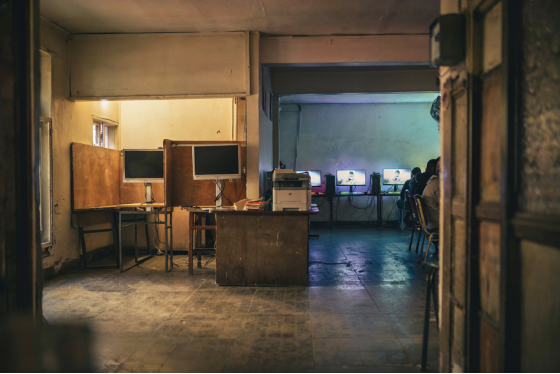
Inside a cabina de internet upgraded with gaming PCs
The cabina de internet, in three acts
Act one was infrastructure. In the late 1990s and 2000s, Peru in particular got online through the cabina de internet rather than through home connections, and the internet cabin model spread across the Andes because the economics fit the street: one shop, a dozen machines, a whole block served. For a while there were cabinas on corners the way there are pharmacies.
Act two was the fall. Smartphones removed the reason most customers walked in, the shops that only sold browsing time closed by the hundreds, and telecom ads were happy to declare the whole category dead.
Act three is quieter and more interesting. The survivors kept the daytime services people still need and added the one thing a phone can't offer: serious hardware for serious games. That hybrid is the business this article is about.
It helps that the surviving shops inherited the best part of the old model for free. A cabina de internet was always a neighborhood institution, the place your aunt trusted with her documents and your cousin trusted with his rank. Twenty years of that trust doesn't show up on a balance sheet, but a new gaming lounge opening cold across the street would pay dearly to buy it.
The daytime business and the evening business
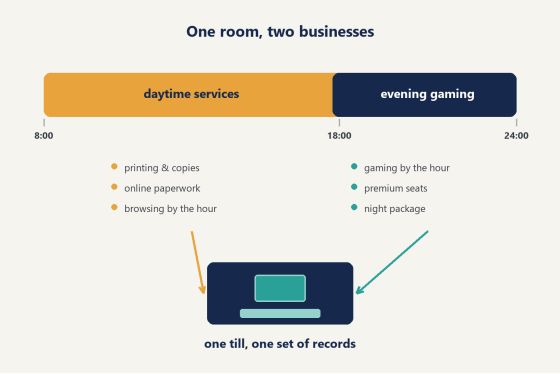
A modern cabina de internet runs two businesses out of one room, and pretending otherwise is how owners end up underpricing both.
Daytime is a service counter. Printing, copies, scanning, video calls, and walking customers through trámites (the online government paperwork that much of daily life in Peru and Bolivia still runs through). The customer sits for twenty minutes, pays a small fee, and is replaced by the next one. Margins per visit are thin. What makes it work is volume and trust, because the shop that prints your CV correctly today is the one you come back to for everything else, including the gaming birthday your kid asks for.
Evening is a different animal. The room fills with five-player groups who stay for hours, buy drinks, and care about frame rates. They pay more per hour, they come on a schedule, and a good Friday can out-earn three days of printing.
The split even shapes the floor plan. Put the service seats and the printer near the door, where a customer in a hurry can be in and out without crossing the room, and give the gaming rows the back wall, where a five-player group can be loud without scaring off the woman printing her tax forms. A curtain of distance keeps both customers comfortable in the same shop.
The two crowds want different machines and different prices. What they share is your till, which is why the record-keeping has to be one system rather than a notebook for the printer money and memory for the rest. More on that below.
Diagram of daytime services and evening gaming revenue in one day
What does a competitive tarifa look like?
Browsing and service time in Peru has sold for a sol or two per hour for years, and that floor hasn't moved much. Nobody gets rich on it. Its job is to keep the room busy in daylight and cover the fixed costs while the printer does the earning.
Gaming time is where pricing gets interesting. A machine with a real graphics card and a high-refresh monitor rents for a multiple of the browsing rate, and regulars accept tiers without complaint: the standard row at one price, two or three premium seats at another, a night package for the group that wants the room after ten. Owners who copy the tier structure from the big-city venues usually find their regulars were willing to pay it all along.
Currency is where the three countries part ways. In Peru you price in soles, and small payments increasingly arrive as QR transfers through apps like Yape rather than coins (cash still rules in the provinces). Bolivia runs on bolivianos, and the till there still leans heavily toward cash. Ecuador is the easy case: the country uses the US dollar, so every number in this article, including the software line further down, reads with no conversion at all.
Run the rough math with middle numbers before committing to anything. Say fourteen seats, a browsing rate near the local floor through the afternoon, a gaming rate at three times that after dark, and the floor two-thirds full from seven to eleven. The evening alone carries the rent in many districts, and the daytime counter, printing included, turns the shop from break-even into a living. Your numbers will differ. The shape of the calculation won't.
Put the tariff rules in writing before opening week. Day rate, evening rate, premium seats, night package, member discount. Five rules is already too many to apply from memory at a crowded counter, and the operations section below is mostly about that exact problem.
Dota 2 country
Every market has a main game, and in the Andes it isn't close.
Peru's Dota 2 community is famous across the entire game, big enough that South American pro rosters lean heavily Peruvian and the regional server stays packed at hours when sensible people sleep. A gaming cabina in Lima without Dota 2 installed is a barbershop without scissors. Free Fire is the second pillar in all three countries, enormous with younger players, and it runs happily on modest hardware through an emulator. Valorant and League of Legends fill out the schedule, with EA FC as the game groups wind down on before the shutters close.
That mix is kind to your budget. Dota 2, League and Free Fire all run well on mid-range machines, so a sensible floor is mostly mid-tier PCs plus a couple of premium seats for the Valorant crowd chasing frames. Spend the savings on chairs and on the network switch, the two purchases players feel every single session.
Patch days are the discipline. A Dota update lands on Valve's schedule, not yours, and the evening crowd arrives whether or not your machines finished downloading. Update before you open. Every day. Outside the capitals this rule matters double, since provincial bandwidth rewards one overnight download over fourteen simultaneous ones at 6pm.
There's a community angle hiding in the game list too. A weekly in-house Dota night with a symbolic prize costs you almost nothing and fills the slowest evening of the week, because the players organize themselves once the fixture exists. The venues that treat their regulars as a league rather than a queue keep those regulars for years.
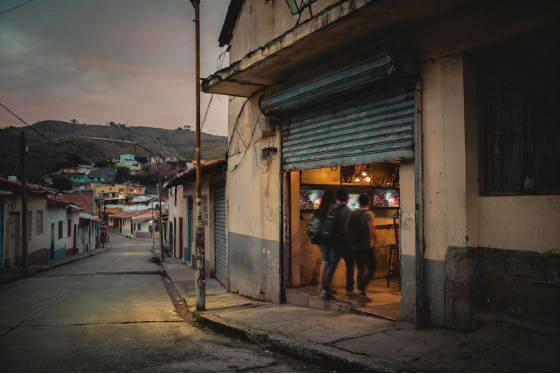
Evening street view of a neighborhood gaming cabina
Keeping one person in charge of everything
Most of these shops run on one person a shift, and that person is often the owner. The same pair of hands works the printer queue and the drinks shelf, then starts gaming sessions, tops up member accounts and answers the phone. Every task done from memory is a place where money quietly leaks, and the leak is worst at the exact moment the shop is doing well, because a crowded counter is where mental arithmetic goes to die.
iCafeCloud is internet cafe management software used by 3,000+ clients in 90+ countries, and it exists for exactly this kind of shift: member accounts and billing, tiered discounts, a shared game license pool, PC and console control, daily reports, all of it visible to the owner from anywhere.
Rates that switch themselves
Set each rule once. The daytime browsing price, the evening gaming price, the premium seats, the night package: they live in the system and change on schedule, with nobody at the counter touching anything. A session starts when the customer logs in, the charge calculates itself, and when time runs out the PC locks on its own. No more glancing at a wall clock between print jobs.
The discount engine reads top-ups and played hours automatically, so a member rate is a rule that fires by itself instead of a card taped to the monitor. Coin Prizes stacks a competitive layer on top: players earn coins from in-game performance and trade them for prizes you price yourself, which fits a market where the same five customers will grind Dota until closing every night of the week.
The license pool, explained with one game
Take EA FC, the game every group wants for twenty minutes at the end of the night. Buying one copy per machine for a title used in bursts is money burned. iCafeCloud holds game licenses in a shared pool instead: a player launches the game, the system lends that session a license, and at logout the license returns to the pool for the next player. Fourteen seats can share a handful of copies if that matches your real peak, and the same logic covers the whole library.
Consoles ride on the same billing and time control, useful if a PlayStation corner is part of the evening plan. Game updates run from the admin side too, which turns the update-before-open discipline into a scheduled job instead of a morning walk from machine to machine.
And the daily report is the quiet favorite. Earnings, expenses, member activity, split by shift, readable from your phone at home while the shop runs an evening without you for the first time in years. In practice this is where the two-business structure finally becomes visible, because you can see exactly what the daytime counter earned against what the evening floor brought in, and stop guessing which half deserves the next investment.
The software line in your budget
iCafeCloud is billed per PC, in USD.
Plan | Monthly | Annual (20% off) |
iCafeCloud | USD 2.50 / PC / month | USD 2.00 / PC / month |
iCafeCloud + CCBoot | USD 4.00 / PC / month | USD 3.20 / PC / month |
For a 14-seat cabina de internet on the annual plan, that's USD 28 a month, which one decent evening of gaming sessions covers. Ecuadorian readers can take those numbers literally. Everyone else converts once and moves on, and the current figures always live on the per-PC pricing page. The bundle row is worth a look if you're weighing diskless boot as well: CCBoot loads Windows and games from one central server, so a big patch downloads once for the whole room, an argument that writes itself wherever provincial bandwidth is the bottleneck.
Prove it in fifteen days
The trial runs the full feature set on your own machines, and the delivery method happens to suit this region: the license arrives over WhatsApp or Telegram, and honestly, WhatsApp is already how half of Andean commerce gets done. There's no card required and nothing to cancel, which makes the decision smaller than it sounds. Worth knowing before you apply:
- Trials cover 10 PCs minimum (up to 100, more in special cases) for 15 days, extendable to 30 on request.
- The server machine needs at least 16GB of RAM and four physical disks. The installer checks the spec, so meet it first and save yourself a loop.
- Log into WhatsApp Web or Telegram on that PC before you start, because the registration code drops straight into the chat. One trial per machine ID.
Fifteen days spans two weekends, and weekends are the test that matters: a full Friday floor with the evening rate switching on schedule tells you more than any feature list. Apply for a trial license through the wiki, or click through the online demo first if you'd rather see the admin side before installing anything. Support runs 24/7, and the site is also available in Spanish if that reads easier.
The cabina de internet earned its corner by selling something scarce, and when connectivity stopped being scarce the obituaries wrote themselves. The shops still standing sell what a phone can't deliver: real hardware and a full row of friends. Wire the prices and the paperwork to run on their own, and what's left of the job is the part worth having: the room on a Friday night, full, loud, yours.