

A LAN shop sells an hour on a PC. A cyber lounge sells an evening.
Almost everything else follows from that one difference. Owners in Singapore tend to read the cyber lounge trend as a fit-out question: darker walls, sofas, a better sign. In my work with venue owners the fit-out has turned out to be the least important part. What changes is the unit you sell, and once the unit changes, the pricing, the customer and the way you manage the floor all change with it.
The short version
| LAN shop | Cyber lounge |
What you sell | An hour at a PC | A block of time in a |
Floor | One kind of seat | Zones: standard, |
Pricing | One hourly rate, perhaps | Several rates plus a |
Typical visit | One to two hours, alone | Three to four hours, |
Management | A timer and a till | Accounts, balances and |
Neither model is the better one in general. The lounge earns more per visit and asks more of whoever runs it.
What a cyber lounge sells that a LAN shop does not
Three things, and none of them is furniture.
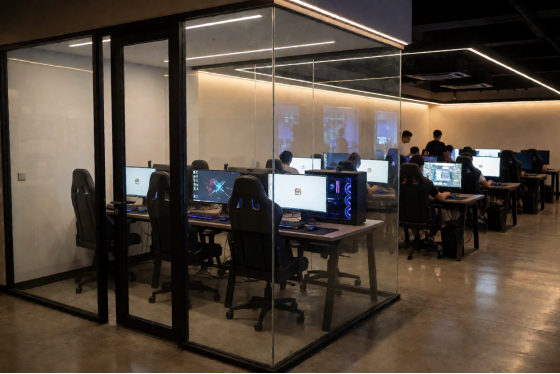
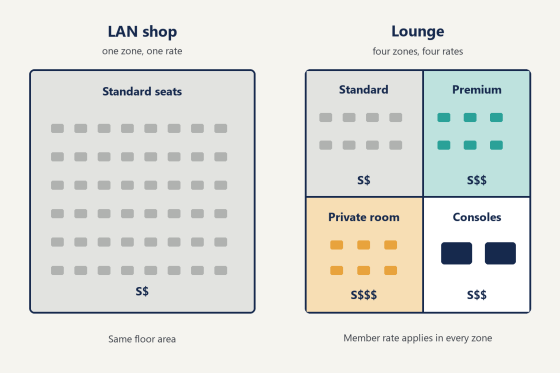
Zones come first. A LAN shop has one kind of seat, so every customer pays the same for the same hour. A lounge divides the floor into a standard area, a premium area with better screens and chairs, and one or more private rooms. The point of zoning is that different customers can pay different amounts for the same hour without anyone feeling overcharged. The student who wants the cheapest seat in the house gets it. The group of five who want a door they can close get that too, and they pay for it.
The private room is where the arithmetic moves furthest. A room is sold to a group, not to a person. Five friends want two or three hours together, and the natural way to price that is by the room. Sold that way, a room that is in use for most of the evening will out-earn the same floor area filled with single seats.
The market is already moving in this direction. In July 2026 a Singapore gaming brand opened its fifth and largest outlet at Clarke Quay: almost 9,000 square feet, open around the clock, with private gaming rooms and billiard tables. That is a large bet on the group customer, and it was not made by a newcomer.
Consoles are the second thing. A corner with two or four controllers serves people who would never sit down at a gaming PC: football fans, couples, colleagues after work. It also takes less floor than a row of desks.
The third is membership. A LAN shop can have members, but in a lounge the member is the product. Home fibre is close to universal in Singapore, so nobody walks in for the connection. People come for hardware they do not own and for somewhere to be with friends. A membership turns that into a habit, with a monthly fee or a prepaid balance on one side and a lower hourly rate on the other. Some Singapore venues already charge a small monthly fee that brings the open-floor rate down by a few dollars.
Glass-walled private gaming room beside the open floor of a Singapore gaming lounge
One price or four
A typical LAN shop has one hourly rate, sometimes split into peak and off-peak. A cyber lounge has at least four: a standard rate, a premium rate, a room rate and a member rate.
Published rates in Singapore suggest roughly S$3 to S$6 an hour at neighbourhood shops, around S$8 for premium rigs, and S$8 to S$12 an hour for private rooms. Those figures come from venue listings and review sites. Treat them as a range and check what the shops within two MRT stops of you are charging.
Floor plan diagram comparing a single-zone LAN shop with a four-zone gaming lounge
The mistake I see most often is in the order of the decisions. Owners set the walk-in rate first and then take a dollar off for members, and the member rate ends up too close to the walk-in rate to be worth joining for.
My advice is to work in the opposite direction. Decide what a regular should pay for an hour, because regulars are the people who fill your weekday evenings. Then set the walk-in rate far enough above it that joining is the obvious choice by the second visit. Premium and room rates come last, as multiples of the standard rate.
Keep peak and off-peak inside this structure if you already use them, but resist adding more. A rate card that fits on one sheet at the counter is the test. If your staff cannot quote every price from memory, there are too many.
Who comes, and for how long
The LAN shop customer is a student after school who wants an hour or two of Valorant or Dota 2, alone or with one friend. That customer is still the core of the business.
The lounge adds two more. Working adults come in a group after office hours, and weekend groups come to mark an occasion. Both stay three or four hours and both spend more per visit. They care less about the last dollar on the hourly rate. They care more about the room, the air-conditioning and not sitting next to a stranger who shouts.
Longer and more varied visits change the job at the front desk. A customer may top up halfway through, move from the open floor to a room when friends arrive, or switch from a PC to a console. The desk cannot follow all of that with a clock and a notepad.
Can one person still run the floor?
In Singapore, one person usually has to. Manpower is expensive and a single member of staff on shift is normal.
Four rates and several zones, on PCs and on consoles, with one person on shift: that does not work on paper. It does work with management software, and the system I will use as an example is iCafeCloud, which runs in more than 3,000 venues across 90 countries. For a cyber lounge, these are the functions that carry the load:
- Every member has an account. The clock starts when they log in and stops when the session ends, and the charge calculates itself.
- When paid time runs out, the machine locks. Staff can start a session, end it or restart a PC from the admin panel without leaving the desk.
- Consoles get the same billing and time control as the PCs.
- Discounts apply on their own once a customer has topped up a set amount or logged a set number of hours. You choose the thresholds.
A daily report then shows earnings and expenses next to member activity, which is how you find out whether the premium zone is paying for itself.
The same supplier is a sensible first call on hardware for that zone. I specify a premium zone by tier, meaning a faster screen and a stronger graphics card than the standard seats, and leave the choice of model to the month of purchase because the shelf changes every year. Their live chat will send the list of models currently on sale.
One piece of sequencing matters more than the rest. Get member accounts and automatic billing running on the floor you already have before you build a single room. An owner who opens the rooms first ends up managing the newest and most valuable part of the venue with the oldest tool in the shop.
You can go through the admin panel in the online demo before committing to anything. Licensing is per client PC, monthly or annual, and the supplier lists the current per-PC pricing on its site. A trial license covers ten or more PCs for 15 days and can be extended to 30 on request, which is long enough to see two full weekends of real customers.
The rent question
Floor space is the expensive input in Singapore, and a lounge uses more of it per customer than a LAN shop does. I will not quote rents here, since they differ too much between a mall unit and a shophouse.
Use one measure instead: paid hours per square foot per evening, multiplied by the rate. A private room or a console corner has to beat the standard seats it displaces on that measure. After a month of daily reports you will know. If the room loses, turn it back into seats.
Which one should you run?
Here is the rule I give owners.
If your seats are already more than 70 per cent full after seven on most evenings, and a visible share of your regulars arrive in groups, move towards the lounge model. Add the member rate and a premium zone first. Build the room second.
If you are not there yet, stay in a LAN shop and put member accounts and automatic billing in place now. The name on the sign can wait. A cyber lounge is what a well-run LAN shop grows into once its evenings are full, and it is far easier to grow into one than to open as one.