

Tuesday, two in the afternoon, a 28-seat room in Calgary. Four seats are taken and one of those is a kid doing homework. Friday at seven the same room has a waitlist at the counter and somebody asking whether the two stations by the window are free yet.
That gap is the whole business. Almost every gaming cafe in North America makes its rent on maybe fourteen hours a week and spends the other sixty trying not to lose money, and the owners who do well are the ones who treat those two situations as different products rather than the same room at different times.
None of what follows is about buying better graphics cards. It is about the four numbers underneath the floor, and what you have to be able to see and control to move them.
Interior of a North American gaming cafe with PC stations and a console lounge area
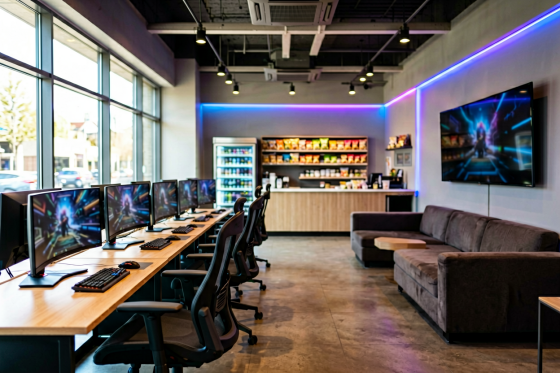
What a gaming cafe looks like in North America now
Start with vocabulary, because it tells you who your customer thinks you are. Nobody in Seattle or Toronto is looking for an internet cafe. They search for a gaming cafe, a LAN centre, an esports lounge, sometimes a gaming lounge, and what they picture is closer to a bar with good PCs than to a room full of terminals.
Twenty to sixty seats is the normal range. Heavy GPUs, because the floor is playing Valorant, League of Legends, CS2 and Fortnite, with Overwatch 2 still on plenty of screens, and because a visible spec sheet is part of what people are paying for. Most rooms also carry a console corner with couches, which does more work than the seat count suggests: it is where the birthday parties and the people waiting for a PC end up.
Pricing sits higher than most of the world. In the US, five to twelve dollars an hour covers most of the market depending on city and hardware. Canadian rates land in a similar band, with third-party roundups of Canadian venues in 2026 putting typical walk-in rates around five to eight dollars an hour and member rates roughly a dollar or two below that. One Toronto venue splits it further, with lounge seats at the low end, the competition stage a couple of dollars above, and a private room for LAN parties at several times the hourly rate. Chains have started appearing in ten or more Canadian cities, which tells you the model works when it is run tightly.
Food and drink matter more here than in most markets. So do peripherals behind the counter, tournament entry fees, and the occasional corporate booking that pays for a slow week in one afternoon.
Worth knowing who actually walks in, because it is not one crowd. There is the after-school group who arrive at four and leave when a parent texts. There is the twenty-something weekend block who book a row of five and stay six hours. There are the players with a decent rig at home who come anyway, for the room and the people rather than the hardware, and who are the most valuable customers a gaming cafe has because they are the ones who bring three friends. Birthday parties and team practice bookings fill the hours nobody else wants. A game cafe that only serves the first group ends up with a busy Thursday afternoon and an empty till (the after-school crowd buys one hour and half a drink, which is not a business).
The four numbers that decide whether the month works
Everything else is detailed. These four are the business.
Seat hours sold is the first one. Not seats, seat hours. A 28-seat room open twelve hours a day has 336 seat hours a day on offer, and it will sell somewhere between fifteen and thirty-five percent of them across a normal week. Knowing your real number is more useful than any advice anyone can give you, because it tells you whether your problem is traffic or pricing.
Second is what an average visit is worth. Hourly rate plus whatever came off the drink fridge and the snack shelf. Owners consistently underestimate this one, and it is usually the number that moves fastest once you start paying attention to it.
Third is cost per seat per month, all in. Rent divided by seats, power, internet, hardware amortized over three or four years, plus what you pay for software and for game licenses. Get this to a monthly figure per seat and every pricing decision afterwards gets easier, because you know the floor beneath which a seat hour is not worth selling.
Fourth is labour, which in North America is the number that quietly eats gaming cafe margins. A shift where one person covers the counter, the floor, the food, and the tech is the difference between a room that works and a room that needs two people on payroll to do the same revenue.
Run those together once and the room stops being a mystery. Take the Calgary example: 28 seats, twelve hours a day, call it 2,350 seat hours a week on offer. Sell a quarter of them at an average of nine dollars all in, food included, and you are at roughly five thousand a week through the door. Now put your all-in cost per seat next to it and you will know within an evening whether the gap you are looking at is a traffic problem, a pricing problem, or a staffing problem, and those three have completely different fixes.
In practice you can improve the first two with marketing and the second two with systems. Most owners spend all their energy on marketing.
Pricing the walk-in rate and the membership behind it
Every gaming cafe ends up running two prices, and only one of them is on the sign by the door.
Walk-in pricing is the easy part. Pick a number consistent with your city and your hardware, keep it simple enough to say out loud, and stop worrying about it.
Memberships are where the month gets stable. The mechanics that work look roughly the same everywhere: a customer tops up an account, and the balance buys time at a better rate than a walk-in pays. Some rooms sell blocks of hours, some sell a monthly pass, plenty do both. The point is the same either way, which is that money arrives before the seat hour is consumed and the customer now has a reason to come back to your room specifically.
Here is the part people get wrong. Tier thresholds should sit just above a natural spend, not on a round number. If a regular normally tops up forty dollars, the next tier at fifty converts a lot of people, and the same tier at a hundred converts almost nobody. Move the threshold, watch what happens for two weeks, move it again (nobody gets this right on the first guess, and the second guess is usually the one that sticks). Discount tiers that trigger automatically on top-up amount or on accumulated hours are standard in cafe management software, and the management side of the business is where you set those thresholds and then leave them alone.
Then there is the Tuesday afternoon problem, which is not a pricing problem so much as a product problem. An empty seat costs you almost nothing at the margin, so the answer is rarely a general discount. It is a different product in that time slot: student hours, a daytime block rate, practice bookings for a local team, an open play session for a game with a community that skews daytime. Sell the room by the slot rather than by the person and the curve flattens without touching your Friday rate.
Do you really need thirty copies of the same game?
No, and the mechanism that fixes it is worth understanding properly, because game licensing is one of the larger line items on a new gaming cafe floor and one of the easiest to overpay for.
A license pool works like a library. You hold a number of licenses centrally, a customer sits down and launches a title, the system hands them a license for the session, and when they log off it goes back into the pool for the next person. Nobody sits at a machine that cannot run the game everyone else is playing, and you are not buying a copy for every seat that might theoretically want it.
Size the pool against your concurrent peak, not your seat count. This is the detail that saves real money. A 28-seat room does not have 28 people playing the same title at once, even on a Friday; peak concurrency for any single game usually runs around sixty or seventy percent of seats at best, and for anything outside your top three titles it is far lower. Watch the numbers for a month before you buy more.
CCBoot handles a related job one layer down, keeping every station booting from a single image so the games themselves only get updated once. Different problem, same instinct: do it centrally, not thirty times.
Diagram of a shared game license pool assigned to active sessions and returned afterwards
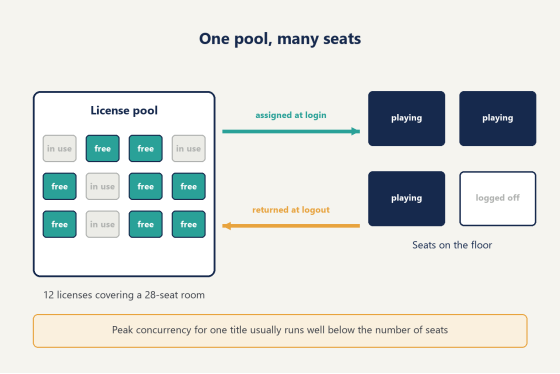
One attendant, forty seats
Labour is the North American constraint, so this section is the one worth reading twice.
The goal is a shift where the person on duty never has to walk the floor for an administrative reason. Sessions start and stop on their own. Time runs out and the machine locks itself, without a conversation and without anyone standing over a customer with a stopwatch. A station that needs a restart gets one from the counter. Consoles bill the same way the PCs do, which matters more than it sounds, because the couch corner is otherwise the place where time tracking quietly falls apart and revenue goes missing.
What that buys you is not really a saved salary. It is attention. The same person can now sell food, run the tournament bracket, greet the group that just walked in, and handle the phone, and those are the things that actually grow the top line.
Console billing, session control, and the member accounts all live in one panel, and it is worth walking through the admin panel in the live demo before you decide how you want your own floor set up, because the shape of the panel tends to shape the shift.
Scheduling follows from this. Once the administrative load is off the floor, you staff to demand rather than to seat count, which usually means one person on a weekday afternoon and two from Friday evening through Sunday, with the second person there to sell and host rather than to police timers. Most gaming cafe payroll problems are really visibility problems wearing a different hat.
One more thing that only shows up after a few months: written-down rules beat remembered ones. Whatever you decide about grace periods, refunds for a crashed session, and who can extend a customer's time, put it in the system rather than in the head of your best employee. Staff turn over. The floor should not.
Reading the day in numbers instead of the till
Counting the cash at close tells you what happened. It does not tell you why, and a gaming cafe that only knows its daily total is flying on one instrument.
A daily report that covers earnings and expenses alongside member activity does, and the useful habit is reading it on the same day every week rather than only at month end. Two weeks of data and you can see which nights carry the room. A month and you can see whether your new membership tier moved anything or just gave a discount to people who were coming anyway.
Loyalty mechanics sit on top of that. Automatic discounts based on hours or top-ups are the baseline. Coin prizes, where players earn coins on in-game performance and spend them on rewards you set, add a competitive layer that gives regulars a reason to pick your room over the one across town, and it runs itself once the prize list is in.
iCafeCloud is used by more than 3,000 venues across 90-plus countries with support running around the clock, which mostly matters at eleven at night on a Saturday when something needs an answer. Licensing is per PC, billed monthly or annually with the annual rate working out lower, and the current per-PC pricing is on the site.
What to have working before your gaming cafe opens
Not a checklist of everything. Five things that are painful to retrofit once you have customers.
- Member accounts and session billing, tested with real money on staff accounts for a week before opening.
- Your license pool is sized and assigned, with your top three titles verified end to end on a station you did not build the image on.
- The lock-on-timeout behaviour sets the way you actually want it, including what a customer sees.
- Console billing configured, not left for later, because later means a summer of untracked couch time.
- One report you can read in thirty seconds, so you look at it every day instead of once a quarter.
Run all of it on a small number of seats before you commit the floor. You can apply for a trial licence and put it on ten seats for a couple of weeks, which is long enough to find the things you would otherwise find on opening night.
Do the counter workflow at the same time, with a stopwatch. A member walks in, gets checked in, sits down, plays, tops up, and leaves. If that round trip takes more than about forty seconds of staff attention on a quiet afternoon, it will take three minutes on a Friday with six people in line, and the queue at the counter is where a gaming cafe loses money it never sees.
Staff checking a member in at the front counter before a session starts
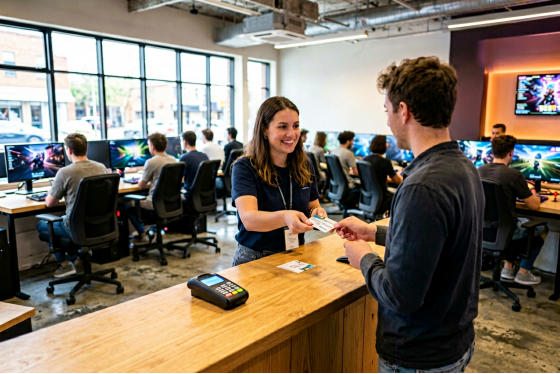
To be fair, most of the pain in opening week is not software. It is the espresso machine, the payment terminal, and the person who did not show up. The point of having the floor systems settled early is that they stop being one of the things that can go wrong.
Back to Calgary and that Tuesday afternoon. The room did not fix its slow weekday by cutting the hourly rate, because a cheaper empty seat is still an empty seat. It fixed it by selling the daytime differently and by making the regulars feel like members instead of walk-ins, and the numbers to prove it came off a report rather than out of the till. That is what running a gaming cafe well looks like from the inside: a few decisions about pricing and access, made once, then watched.