

Somebody sends me a spreadsheet about once a month. Thirty-four seats, a unit somewhere in the heartland, a tab called "Sheet1" with rig prices copied off a build site and one cell for rent that has been guessed at three times. Everything below that is empty, because the hard part of opening a LAN gaming shop in Singapore is not the machines. It is knowing which lines belong on the sheet at all.
So here are the lines, with the 2026 numbers I can actually source, and the arithmetic that turns them into a seat-hour target you can design a room around.
Two notes before the money. Rates quoted by other venues are a map and not a menu, and every figure below moves with the quarter you sign in.
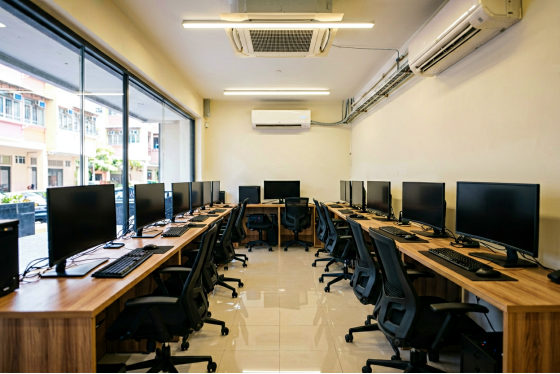
Compact rows of gaming PCs in a Singapore heartland shop unit
The first decision is the postcode, not the PCs
Floor area comes before hardware, because it sets the number that repeats every month for the length of your lease.
Budget 25 to 30 square feet per seat once you have accounted for the counter, walkways, a store cupboard, and somewhere for people to put their bags. A 34-seat room lands somewhere around 900 to 1,100 square feet. Sixty seats pushes you past 1,600.
Now the rate. Retail units in HDB heartland malls have been quoted around S$13 to S$20 per square foot per month, which on a thousand square feet is a rent line between thirteen and twenty thousand dollars. Prime mall space sits above that band, and Knight Frank has projected prime retail rents rising another two to four percent through 2026, so the gap is not closing.
This is why almost nobody opens a LAN gaming shop on a ground-floor mall frontage. Second-floor units, rear-facing shops, and converted light-industrial space all trade footfall for a rent line you can survive, and footfall was never how this business got customers anyway. People come because a friend told them, or because they found you on a map and booked a row for Saturday. A gaming cafe is a destination, not an impulse buy, so paying frontage rent is paying for something you do not use.
For the worked example below, assume you find a second-floor unit and land at around S$9,000 a month. Put your own figure in when you get a real quote.
Fitting out the floor
Rigs first, because that is the number every LAN gaming shop budget starts with and the one people get wrong in an interesting way.
Custom builds in Singapore run roughly S$1,200 at the entry level, S$1,800 to S$2,500 through the middle, and S$3,500 and up once you are into current high-end GPUs. Thirty-four mid-range machines cost somewhere around S$60,000 to S$85,000 before monitors.
The mistake is speccing the whole floor to the same tier. Most rooms that work run the bulk of their seats mid-range and keep four to eight premium stations at a higher hourly rate, because the top tier sells at a premium to a small number of people who specifically want it, while the middle tier is what fills on a Tuesday. Buying thirty-four flagship rigs converts capital into a rate card nobody in the heartland will pay.
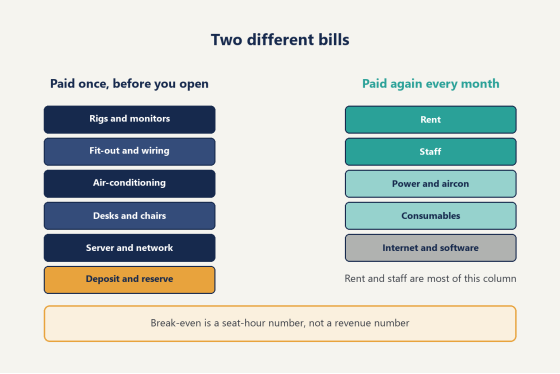
Then the rest of the one-off list, which people underestimate by about half:
- Monitors and peripherals, headsets included. High refresh matters more than resolution here, and peripherals are consumables on a two-year cycle rather than a purchase.
- Desks and chairs, plus cabling. Chairs get eight hours a day of use and cheap ones fail inside a year.
- Fit-out: partitions and flooring first, then lighting, then the electrical work to get enough circuits to the walls. This is where quotes vary by a factor of three depending on the state of the unit.
- Air-conditioning, which in Singapore is not an optional line and not a seasonal one.
- Network gear, a server, and a rack or cupboard to put it in.
- Deposit, typically two to three months of rent, plus whatever the landlord wants for reinstatement.
One line you can decide either way: whether every machine gets its own drive. Running the floor diskless from a single image means storage lives in one box instead of thirty-four, and CCBoot is what handles that side if you go that route.
Keep enough in reserve to run six months at zero revenue. Not because anything is going to go wrong, but because the ramp from opening day to a full Saturday takes about that long, and a shop with a runway makes better pricing decisions than a shop without.
What a LAN gaming shop costs you every month
Rent you already have. Here is the rest of it, and the power line is more interesting than it used to be.
Singapore's regulated tariff for July to September 2026 is 31.91 cents per kWh before GST, 34.78 cents with it, after an overall increase of around 17.5 percent on the previous quarter. Commercial supply is contracted rather than tariffed, so treat that as the reference point rather than your invoice, but the direction is the direction.
Now the arithmetic that matters. A gaming rig with its monitor pulls somewhere around 400 to 500 watts under load and maybe 120 to 150 idling with nobody on it. That three-to-one gap is the whole point: what drives your power bill is utilisation, not seat count. Take the 34-seat room at 40 percent average occupancy across a 14-hour day, and you are drawing roughly 250 watts averaged across every seat, which works out to be nearly 3,700 kWh a month, or somewhere close to S$1,300 at the reference tariff.
Air-conditioning then lands in the same order of magnitude, sometimes above it, because thirty-four machines is a space heater running in a tropical climate. Size the aircon for the heat the room actually makes rather than for the floor area, and get that into the fit-out quote rather than discovering it in month two.
Staffing is the other big line. A 14-hour day is two shifts, which is two full-time-equivalent positions at minimum for a room that also sells drinks and handles bookings. Put your own local wage figure against that. What you can control is how much of the shift goes on administration rather than on selling, which is the subject of the leak section further down.
The Internet is a small line in Singapore and not worth agonising over. Business fibre is cheap and everyone has it, which is also why nobody is coming to your shop for bandwidth.
The last recurring line is the management software, billed per PC per month with the annual rate working out lower than monthly. It is one of the smaller numbers on the sheet, and the current per-PC pricing is on the site.
The monthly bill at three sizes
Planning ranges, not quotes. Rent assumes the kind of unit described above rather than mall frontage.
Monthly line | 24 seats | 34 seats | 60 seats |
Rent (non-frontage unit) | S$6,000 to 9,000 | S$8,000 to 13,000 | S$14,000 to 22,000 |
Power, rigs at ~40% use | S$800 to 1,000 | S$1,200 to 1,500 | S$2,100 to 2,700 |
Air-conditioning | S$900 to 1,600 | S$1,300 to 2,200 | S$2,300 to 3,800 |
Staff (2 FTE, more at 60) | 2 FTE | 2 FTE | 3 FTE |
Internet and phone | S$150 to 300 | S$150 to 300 | S$200 to 400 |
Management software | per PC × 24 | per PC × 34 | per PC × 60 |
Consumables and misc | S$600 to 1,200 | S$800 to 1,600 | S$1,400 to 2,600 |
The shape of that table is the lesson. Rent and people are the business; everything else is rounding.
How many seat hours pay for a LAN gaming shop?
Work backwards from the bill.
A 34-seat room open 14 hours a day has about 14,300 seat hours a month on offer. That is the inventory. It is perishable, it does not carry over, and an empty seat at three in the afternoon is gone in a way that unsold stock is not.
Blended rate comes next. Singapore rooms sit in three broad bands, roughly S$1.50 to S$3 at the budget end, S$3 to S$6 in the middle, and S$6 to S$12 at flagship venues during peak windows. Say you run S$3 off-peak and S$6 peak, and say sixty percent of your hours sell off-peak. That blends to S$4.20 a seat hour before food and drink.
Put the two together. A monthly fixed cost around S$21,000 needs roughly 5,000 seat hours sold, which is about 35 percent utilisation. Add the drinks fridge and it comes down further, because food and drink carry a better margin than time does and cost you nothing in seat capacity.
Realistically, thirty-five percent is a target a LAN gaming shop designs toward rather than hopes for. It means Friday and Saturday evenings close to full, weekday evenings respectable, and something deliberate happening in the daytime instead of an empty room: student rates, block bookings for a team practising, a fixed-price afternoon package. Prepaid memberships matter here for a reason that has nothing to do with loyalty, which is that money arriving before the seat hour is consumed is the difference between a comfortable month and a nervous one.
Breakdown of one-off setup costs against the monthly running costs of a gaming shop
Where the money leaks out
Every LAN gaming shop I have looked at closely was losing somewhere between five and fifteen percent of its revenue to things nobody had ever decided to give away. Not theft, and rarely carelessness. It is what happens when a rule exists in somebody's head instead of in the system, and the person holding the rule is nineteen years old and facing a customer who wants twenty more minutes. Every shift makes a reasonable call at the moment. The sum of those reasonable calls is a number you would not have approved if anyone had put it in front of you as a discount policy. In practice the leaks are the same four, in roughly this order.
Console time is the biggest one and the least noticed. The couch corner has no login, so time gets tracked in somebody's head or on a piece of paper, and on a busy Saturday it gets tracked nowhere at all. Billing consoles the same way the PCs are billed closes it, and the billing and membership layer treats a console session as a session like any other.
Second is the quiet extension. Time runs out at nine, the customer is mid-match, the person on shift does not want the confrontation, and twenty minutes goes unbilled. Multiply by a few a night. When the machine locks on its own at the end of paid time, nobody has to make that decision, and the awkward conversation stops existing rather than getting resolved in the customer's favour every time.
Third is the friend rate, which is not theft so much as an absence of a rule. Staff discretion without a defined discount tier means every regular gets a different price depending on who is working. Set the tiers in the system, based on top-up amount or accumulated hours, and the discount becomes a policy instead of a favour. It is worth walking through how the session and console controls behave in the demo before you decide what your rules should be, because the shape of the tool tends to shape the policy.
Fourth is licenses. Buying a copy of a title for every seat is the most expensive way to do it, and a shared pool sized to your concurrent peak is the cheapest. Peak concurrency for any single game runs well under your seat count, even at full occupancy, because the floor is never all playing the same thing.
Then there is the daily reconciliation, which is less a leak than a blindfold. A report showing takings and expenses alongside member activity, read on the same day each week, tells you which of the four above is actually happening in your room instead of which one you assume is.
What to settle before you sign the lease
Five things, and all of them are cheaper to decide now than to retrofit around customers.
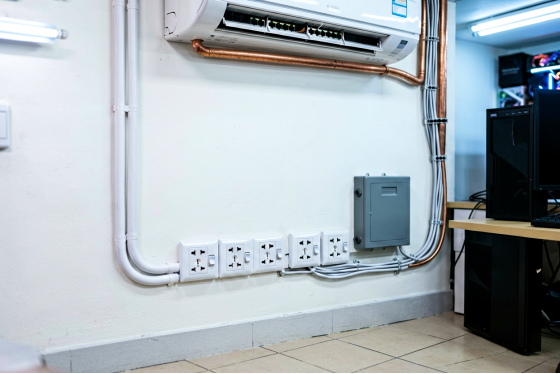
Know your electrical capacity before you commit to a seat count, because upgrading the supply in a heartland unit is a landlord conversation and a licensed contractor, not a weekend. Know your aircon load the same way.
Have your rate card written down, including off-peak, peak, member tiers, and what a block booking costs, before you build anything. It changes what you buy.
Decide the console policy at the same time as the PC policy. Rooms that leave it for later end up with an untracked corner for a year.
Run the whole thing on a small number of machines before the floor exists. You can put a trial licence on ten machines for a couple of weeks, which is enough to test a member top-up, an auto-lock, a console session, and a daily report against real behaviour rather than against a feature list. iCafeCloud runs in more than 3,000 venues across 90-plus countries with support on hand around the clock, which is the part that matters at eleven on a Saturday night.
Last one: leave the reserve alone. It is not part of the fit-out budget.
Power trunking and air-conditioning in the corner of a small gaming shop
None of the five costs anything to decide today. All five cost real money to change once there are thirty-four machines bolted to desks and a queue at the counter on a Saturday, which is the general shape of every decision in this business: cheap in the planning, expensive in the room.
That spreadsheet at the top has about fifteen filled cells now, and the important one is not the total. It is the seat-hour number at the bottom, because everything you do afterwards, from the rate card to the Tuesday afternoon promotion to whether you open at eleven or at two, is a way of moving it. Get the postcode and the power right, keep the leaks closed, and a LAN gaming shop in Singapore is a business with numbers you can actually steer.