

Seven in the morning in Ikeja. The gate is halfway up, two boys are already waiting outside to print a JAMB slip, and the first thing you check is not the machines. It is the light.
Whether NEPA is holding this morning decides the shape of the next four hours in your computer shop: what you print now instead of later, whether the Windows update you postponed on Sunday can finally run, and how much of today's takings ends up in the gen tank instead of your pocket. Most articles written for people opening a shop here stop at the setup list. Rent, fourteen systems from Computer Village, a printer, an inverter, a signboard, a name. Then they end, as though the buying were the difficult part.
Buying is the easy part. A computer shop in Nigeria is two businesses sharing one counter, running on three different kinds of electricity, staffed by someone who might not be there next month. Everything below is about that day, not about opening day.
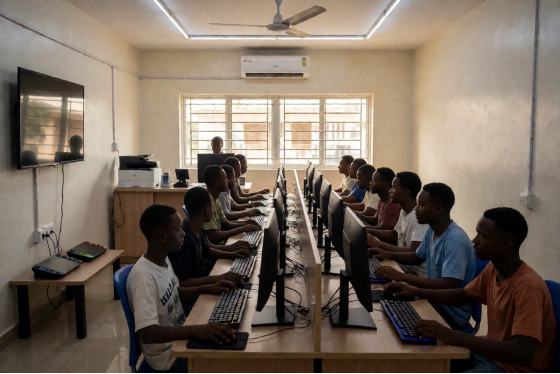
Customers at the workstations of a busy computer shop in Lagos during the morning rush
The two kinds of money a computer shop takes
Stand behind the counter of a Nigerian computer shop for one afternoon and you will hear two rhythms.
One is per item. A page printed, a document scanned, a passport photograph, a CV typed and formatted, a NIN slip, an online form filled for somebody who does not trust themselves with the keyboard, a recharge, a POS withdrawal for a customer who walked in with nothing but a card. Small amounts, quick, forty or fifty times a day, each one at its own price.
The other is per minute. Somebody sits at system 6 and a clock starts. Browsing, coursework, a long email, a YouTube tutorial, whatever they came for. Nothing is sold until time passes, and time passes whether they are typing or watching TikTok on their phone with the machine idle in front of them.
Both land in the same drawer, in three forms: cash, POS, transfer. That is where the month goes blurry. You know roughly what came in. You know exactly what went out, because the fuel and the DisCo and the landlord all send you figures in writing. What you do not know is which of the two lines carried the other.
Operators guess, and the guess tends to lean the same way. Printing and registrations feel small because each sale is small, so they get treated as a side thing next to the seats, when in a lot of shops around a school or a polytechnic those small sales are quietly paying the rent. Seats feel like the main business because they are what the sign outside promises. (The sign is rarely accurate. Plenty of shops with "cyber café" painted on the awning now take most of their money from a printer and a PS5.)
The fix is not complicated, it is just unglamorous: record the item sales and the timed sessions separately at the moment each one happens, not from memory at closing. Cafe management software that keeps both lines on one screen does that as a matter of course, and iCafeCloud handles the sale of a printout and the billing of session 6 in the same back office, which means at the end of the month you have two columns instead of one figure and an opinion.
Light decides the timetable
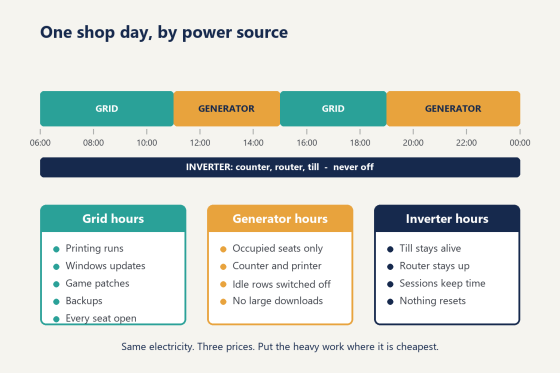
Three kinds of power, three prices, and your day should be built around the gap between them.
Grid power on Band A runs about ₦209.50 per kWh before VAT, with some DisCos quoting nearer ₦225 for customers on the 20-hour-plus feeders. Petrol has been sitting between ₦1,300 and ₦1,400 a litre through September 2026, and once you divide a small generator's fuel burn by the units it actually produces, the figure people quote lands somewhere between ₦600 and ₦900 per kWh. Same electricity. Three to four times the price.
Do the arithmetic for your own computer shop rather than trusting anyone's example, because the answer depends on your machines and nothing else, but the shape of it looks like this: a fourteen-seat room drawing roughly 150W per workstation and monitor, plus the printer, the router and whatever fans are running, sits around 3 kW with the floor full. On a grid that is a little over ₦600 an hour. On the gen, the same hour costs ₦2,000 or more before you have thought about oil, servicing, or the boy you send to buy fuel. Measure it properly if you can. A clamp meter from Computer Village costs less than one bad week of fuel and settles the argument for good.
That gap is a timetable, not a complaint.
Work that eats power and bandwidth goes in the light hours. Long printing runs, system updates, game patches, anything you are downloading, the backup. Gen hours are for seats that actually have somebody in them, plus the counter. Idle rows come off.
One practical thing worth doing before you need it: find out which sockets sit on which circuit and label them, so you can drop the back row while the counter, the printer and the router stay alive, instead of walking around unplugging things in the dark with a customer mid-transaction. Most shops learn their own wiring during a blackout with a queue at the door. Learning it on a quiet Tuesday is cheaper. Write the labels on tape and stick them on the sockets themselves, not in a notebook, because the notebook will not be there when the new boy is on duty at 8pm and the gen coughs. In practice, that single afternoon of labelling is what separates a shop that loses fifteen minutes to a power change from one that loses an hour.
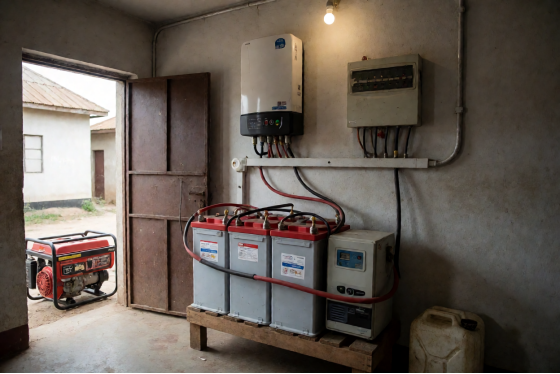
The inverter and battery bank sit in the middle of all this, and they earn their keep in a way that is easy to underrate. They are not there to run the whole floor. They are there so the counter never goes dark, so the router stays up, and so a session a customer already paid for does not die at minute 19 of 60. A customer whose hour was interrupted wants that hour back, and whether they get it depends on whether anyone can prove how much of it they used. That is a billing question dressed up as a power question, and it is the reason the till and the batteries belong in the same conversation.
Diagram of a shop day split into grid, generator and inverter hours with the work scheduled in each
The counter that does not depend on who is on duty
Your staff will change. Sometimes it is a cousin, sometimes a student who leaves when the semester starts, sometimes both in the same quarter. A computer shop that runs on one person's memory runs fine until that person travels.
So the counter needs to hold the details itself.
Every customer gets an account with a balance. The clock starts when they log in and stops itself when the balance runs out, and the machine locks rather than waiting for somebody to notice. Whoever is on duty sees all fourteen systems on one screen: which are in use, which are idle, how long each session has left. Sessions can be started, ended or extended from the counter without walking down the row, which matters most on the evenings when one person is handling the printer and the floor at once. That is the whole point of putting a computer shop on cafe management software rather than a hardcover notebook.
Free time is the leak nobody puts in a plan. Regulars get it, relatives get it, your staff's friends get it, and none of it is written anywhere. Put it through the account instead. Top up the customer's balance with the free hour rather than waving them onto system 9, and that hour becomes a line in the report, which is what marketing spend is supposed to be. You will be surprised how much you were giving away, and you may decide it was worth it. That is a different feeling from not knowing.
Handover is three numbers, every shift, no exceptions. Cash in the drawer. The POS and transfer total on the terminal. Then the shift report the system produces for those hours. When the three agree, the shift is closed. When they do not, you find out that same evening while everyone still remembers who did what, instead of on the 30th when nobody remembers anything. You can try the admin side on the live demo before deciding how you want your own shifts to close.
The PlayStation corner earns on a different clock
Plenty of shops in Lagos, Aba and Port Harcourt are not browsing centres any more. The typical computer shop there is half business centre and half game centre, and the half with the TVs is the one with the queue on Saturday.
Football is the reason. EA FC 26 goes for around ₦99,000 at retail here, which tells you something about why customers would rather pay you by the hour than buy it, and a console with four pads and a good TV turns one screen into four paying customers who brought two more to watch.
Bill it on the same system as the PCs. iCafeCloud does console sessions alongside PC sessions, so a pad hour and a browsing hour both have a start, a stop and a price, and both show up in the same day's report. Price them separately, obviously. The pad hour is entertainment and can carry a higher rate, especially in the evening and on weekends, while the browsing hour is competing with the shop two streets down that charges ₦100 to ₦200 like everyone else.
Saturday tournaments are worth the trouble. Small entry, a prize the winner actually cares about, a room full of people who each bought time to be there. iCafeCloud has a coin system for this sort of thing, where players earn coins on performance and spend them on prizes you set, which saves you running the whole thing off a WhatsApp group and your own memory.
Exam season is the closest thing to a peak
Ask anyone running a computer shop near a secondary school what their year looks like and they will describe a wave, not a line.
UTME registration opens and the printer does not rest. Then WAEC and NECO results, then admission checking, then NYSC registration, and in between there is NIN enrolment and whichever verification exercise has just been announced with two weeks' notice. Those weeks can carry a slow month on either side of them, and they are also the weeks when a shop most looks like it is drowning: a queue, one printer, a student who needs the same slip reprinted because the first one smudged.
Two things make that wave manageable, and both are ordinary.
Take bookings with a deposit, straight into the customer's account balance. The student who wants a machine at 9am on Friday for a CBT practice session has paid for it, so the slot is real, and the deposit is not sitting in an envelope waiting to be argued about. Set up a student member group with its own rate while you are at it, so nobody at the counter is doing mental arithmetic on who gets the discount.
Then look at last year before this year's wave arrives. If the daily reports for that fortnight are sitting in the system, you know what the shop actually did, hour by hour, and you can staff the counter and stock the paper against real figures instead of a feeling. Shops that do this stop running out of toner on the busiest Thursday of the year.
If you plan to go further and become an accredited CBT centre, that is a separate application with JAMB and its own requirements, which is a different article from this one.
What does patch day cost on a Nigerian connection?
Bandwidth here is not a background utility. It is a line item you feel.
A Starlink kit runs ₦669,000, with Residential plans between ₦57,000 and ₦75,000 a month, and in the congested parts of Lagos and Abuja the plan on offer for a business is the Priority one at ₦159,000. Fibre where you can get it is cheaper per gigabyte and fussier about where your street is. Either way, the number is big enough that you do not want to pay for the same download fourteen times.
Which is exactly what an ordinary computer shop does. CS2, Call of Duty, GTA Online and EA FC each patch on their own schedule, some of those patches run to tens of gigabytes, and if all fourteen workstations fetch their own copy then one patch day can eat a serious share of the month's data while the floor sits half-unusable and customers walk to the shop down the road.
Two habits deal with it. Keep the game licences in a shared pool instead of buying a copy per machine, so a title goes to whoever is playing and returns to the pool when they finish. And update once, centrally: on a diskless setup such as CCBoot the patch is applied to the image on the server and every client picks it up on reboot, so the download happens a single time and the whole floor comes back identical.
Schedule the download in a light hour. You already know why.
Inverter, battery bank and stabiliser stacked in the back room of a Nigerian browsing centre
When the second shop opens
The second location is usually where the wheels come off, because the thing holding the first one together was you being in the room.
Cloud-based management is the answer to that, and it is not exotic. Both branches report into the same dashboard, you see today's sessions and today's takings for each, and staff at the new computer shop work the same member accounts and the same price groups as the old one. Honestly, the feature you will use most is the dullest: checking a shift from your phone while stuck in traffic on Third Mainland Bridge. (You will do this more often than you expect, and always at about 7pm.)
What the software side of a computer shop costs
iCafeCloud is 2.50 USD per PC per month, or 2.00 USD per PC per month paid annually, which works out at 20% off. If you also want the diskless side, the iCafeCloud and CCBoot bundle is 4.00 USD per PC per month, or 3.20 USD annually. The per-PC price list has the current figures.
For that fourteen-seat shop in Ikeja, the monthly plan is 35 dollars a month for the whole floor, and the annual one is 28. Put that beside a single day of running the gen and you have the comparison you need.
The company behind it serves more than 3,000 venues across 90-plus countries with support running 24/7, which for a Nigerian operator mostly matters at one specific moment: something is wrong at 10pm on a Friday with a full house, and you would like a human being to answer. You can apply for a trial licence and run it on your own floor before you decide anything, or talk to the team on live chat if you would rather ask questions first.
Start with one week
Pick a week and write down three numbers at the end of each day: hours on grid, hours on gen, and hours actually sold across the seats and the pads. Keep the printing and registration takings in a separate column from the seat takings while you are at it.
Seven days is enough. By Sunday you will know which line of your computer shop is carrying the other one, what an hour of darkness really costs you, and which two systems in the corner earn so little that they should be switched off during gen hours. Everything after that is just scheduling.