

If you grew up in Singapore in the 2000s, you already know what a LAN shop smells like. Instant noodles, air-con set too cold, someone shouting about a missed smoke lineup on Dust2. Then smartphones arrived, home fibre got absurdly good, and most of those shops quietly folded. For a decade the LAN shop looked like a dead business.
It isn't. In April 2025, Dreamcore opened HAVEN at Kallang Wave Mall backed by Corsair and MSI, with MyRepublic on the pipes and Paper Rex on the marquee, the same Paper Rex that keeps tearing through international Valorant brackets. Wanyoo runs a polished outlet in the Lavender area. The Colosseum at Downtown East still fills up for Dota 2 events. The business came back. It just came back different, and if you're thinking of opening one or you've just taken one over, the difference is the whole game.
Why LAN shops are back
Nobody needed a LAN shop for the internet after 2010. Fibre reached practically every HDB block, and a mid-range home PC ran most games fine. So the shops that survived, and the new ones opening now, sell something else entirely.
They sell hardware you wouldn't buy for yourself. An RTX 5080 rig driving a 360Hz monitor is a serious purchase at home. At a gaming cafe it costs a few dollars an hour, and when the next GPU generation lands, upgrading is the owner's problem instead of yours.
They sell the room. Five friends, one row, voice chat replaced by actual shouting (and yes, the air-con is still set too cold). Discord never quite replicated that, and the generation that grew up on Discord is finding it out in person.
And they sell the scene. HAVEN launched with a pro team attached to its name. The Colosseum has made community events part of its identity for years. Good Speed Game Cafe, one of the older names still standing, runs regular in-person sessions and keeps a genuinely loyal crowd around it.
Rates settle into three rough bands. Budget outlets sit around S$1.50 to S$3 an hour, and a few classic spots still do the first hour at $2 and every hour after at $1. The middle of the market runs S$3 to S$6, often with better rigs at a dollar more. Flagship venues charge S$6 to S$12 during peak windows for top-shelf hardware and the esports branding that comes with it. Those numbers come from the venues' own published rates and local roundups, and they move, so treat them as a map rather than a menu. Where you sit in that spread decides almost everything else about your operation, from fit-out budget to what you can pay staff.
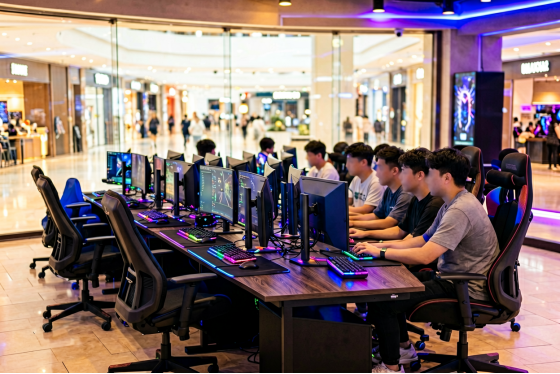
A busy LAN shop in Singapore with rows of gaming PCs
What makes Singapore different
Three things, mostly. Rent and labour first, then the awkward fact that every customer already owns a decent computer.
Rent first. The venues getting press are in malls now, Kallang Wave, Downtown East, not in the walk-up units of twenty years ago, and mall rent in Singapore does not forgive a slow month. Every idle seat-hour has a cost you can put an exact number on, which is why peak-hour pricing here isn't a growth hack, it's survival arithmetic.
Labour is the second constraint, and it shapes the whole staffing model. Most LAN shops here run one person a shift. That one person handles walk-ins, top-ups, the drinks fridge, a parent asking about birthday packages, plus a machine in the corner that needs a restart. Anything that requires the counter staff to watch a clock or apply a discount from memory will go wrong on a busy Friday, not because the staff is bad, but because Friday is Friday.
The third is the strange one: your competitor isn't a slower connection, it's the customer's own bedroom. A Singapore LAN gaming shop wins on hardware tier and atmosphere or it doesn't win at all. That's why the new wave leans so hard into esports identity, tournament nights, squads booking a row after Friday book-out, memberships that make the place feel like a club instead of a rental counter. The Friday-evening book-out crowd is its own institution here, five guys straight from camp with a row booked ahead, and the shop that makes that booking painless keeps that squad for their whole national service.
If you're picking a lane for a first LAN shop, I'd take the middle band and put the savings into better chairs and cooling rather than chasing the flagship tier. HAVEN-class fit-outs come with HAVEN-class rent and sponsor relationships you probably don't have yet. A S$3-to-S$6 room with honest mid-tier rigs is where a neighbourhood five-stack settles in for a four-hour session, and five-stacks are repeat business.
None of this is a reason to stay out. It's a reason to run tighter than the last generation of owners ever had to.
What do people actually come to play?
The list is shorter than you'd think, and it decides your hardware order. Valorant and CS2 fill the most seats in Singapore right now, with Dota 2 and League of Legends holding the five-stack crowd, while EA FC pulls in groups who honestly just want football with live commentary from the next chair. Fortnite still moves on weekends, and a few venues keep PUBG Mobile running on emulator setups for the crowd that grew up on the phone version.
The shooter-heavy mix is why 240Hz is the floor for monitors in the mid band and why flagships advertise 360Hz panels. Frame rate is the product. A tactical-shooter regular can feel the difference between your rig and his bedroom setup inside a single round, and that feeling is what he's paying for.
The mix shapes the room too. Five-stacks want a full contiguous row, not five scattered seats, so plan your rows in fives and accept that team voice runs loud. The EA FC and fighting-game crowd drifts toward the console corner. A Dota night will run past the last train, which is an argument for overnight packages and for rates that switch bands at midnight without anyone touching the till.
And it sets your update rhythm. Patch days for the big titles land on their schedule, not yours, and a floor that opens at noon with half its machines still downloading is a floor earning nothing that afternoon. Update before open, every day, the way a kopitiam preps before the lunch crowd shows up.
Where the money actually comes from
Straight hourly rental is the visible revenue, and the smallest interesting part of it.
Look at how the venues that lasted actually price. Peak and off-peak splits are standard, something like S$3 on a weekday afternoon against S$6 on a Saturday night. Memberships convert walk-ins into regulars: one common structure is a one-time fee around S$100 that buys a permanently discounted rate, say S$1.50 an hour before 7pm. Prepaid top-ups with bonus credit pull cash forward, and a $50 top-up that credits $58 keeps a student coming back to your floor instead of comparing hourly rates across town.
Then there's everything that isn't a seat. Drinks and instant noodles carry better margins than the PCs do (the fridge, again). Price the noodles fairly and keep the drinks cold. The counter is a second till, not an afterthought. Private rooms are rented to birthday groups and streamers. Whole-floor buyouts for tournaments and corporate LAN nights can outnumber a normal weekend, and Colosseum has been proof of that model for years. A LAN shop with 38 seats and no event calendar is leaving one of its best revenue lines switched off.
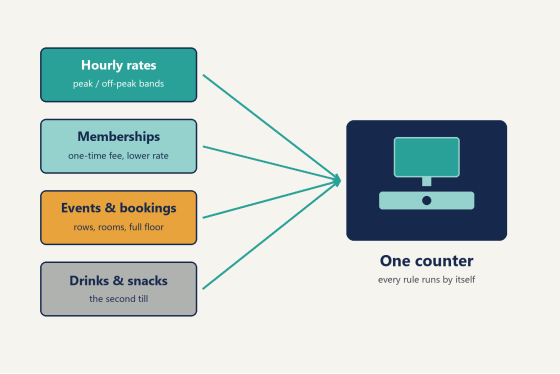
Notice what this revenue structure demands, though. Peak windows, member tiers, bonus-credit ladders, room rates, coin promotions: that's a lot of pricing rules running at the same time, on a floor staffed by one person. Nobody administers that from a spreadsheet at 11pm on a Saturday. The shops that make layered pricing work are the ones where the rules execute themselves.
Diagram of revenue streams flowing into a gaming cafe counter: hourly rates, memberships, events, snacks
The operations layer: billing, members, licenses
This is where management software earns its keep, and it's the part I'd get right before spending a single dollar on RGB. iCafeCloud is cyber cafe management software built for exactly this kind of venue, used by 3,000+ clients across 90+ countries, and its feature list reads like the previous section's demands answered one by one: member accounts, session billing, a shared game license pool, PC and console control, daily reports.
Tiered pricing without staff intervention
Set the rate rules once. Weekday off-peak, weekend peak, member rates, top-up bonus ladders: all of it lives in the system, and the Saturday-afternoon price switch happens whether or not anyone is behind the counter. The clock starts when a customer logs in, stops when the session ends, and the charge calculates itself. When time runs out, the machine locks on its own, which retires the awkward ritual of tapping a stranger on the shoulder mid-ranked-game.
The discount engine reads top-up amounts and logged hours automatically, so that S$100-member-rate idea from the last section isn't a laminated card behind the counter, it's a rule that fires by itself. Same with Coin Prizes: players earn coins on in-game performance and trade them for whatever you've priced into the shop, which gives a competitive crowd one more reason to make your LAN shop their home venue.
One game library, shared across the floor
Buying a copy of every game for every seat is the quiet budget killer in this business. iCafeCloud keeps a shared license pool instead. A player launches a game, the system assigns a license from the pool for that session, and when they log off it goes back for the next player. Your 38 seats don't need 38 copies of a title that peaks at 11 simultaneous players on a Friday night.
For a Singapore floor, the pool covers the titles that actually fill seats here: Valorant and CS2 first, Dota 2 and League of Legends for the five-stacks, EA FC for the group that treats your shop as a football club. Consoles get the same billing and time control as the PCs, worth knowing since plenty of new-wave venues run a console corner alongside the rows.
And the reports. Earnings, expenses, member activity, pulled at the end of any shift. Slow Tuesday afternoons show up in the numbers before they show up in your bank balance, which is exactly when an off-peak promotion is cheapest to run. In practice the loop is short: read the report, spot the soft hours, point a promotion at them. Game updates run from the admin side as well, so patch day is finished before the shutters go up.
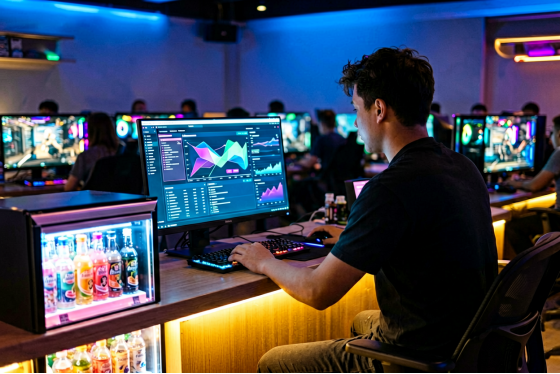
Front desk of a gaming cafe with one staff member managing the counter
What the software side costs
iCafeCloud bills per PC, in USD.
Plan | Monthly | Annual (20% off) |
iCafeCloud | USD 2.50 / PC / month | USD 2.00 / PC / month |
iCafeCloud + CCBoot | USD 4.00 / PC / month | USD 3.20 / PC / month |
For a 38-seat LAN shop on the annual plan, that works out to USD 76 a month, which one regular on a mid-band rate covers in a couple of weekends. Current numbers are on the per-PC pricing page. The bundle row is worth a look if you're also weighing diskless boot, where CCBoot loads Windows and games from a central server so a 90GB patch downloads once instead of 38 times.
Run the same maths for your own floor: seats times two dollars, held against your cheapest hourly rate, tells you how many billed hours a month the software layer costs you. For most rooms it's one evening.
Try it on your own machines first
The trial runs the full feature set on your actual floor, which is the honest way to evaluate anything in this category. A few things worth knowing before you apply:
- Trial licenses cover 10 PCs minimum (up to 100, more in special cases) and run 15 days, extendable to 30 on request.
- Put the server component on a machine with at least 16GB of RAM and four physical disks. The installer checks the spec, and meeting it before you apply saves a round trip.
- The license arrives over WhatsApp or Telegram, so log into whichever you use on that PC before starting. One trial per machine ID.
Fifteen days is enough to run two full weekends, and the weekends are the real test: if the Saturday peak switch and the license pool hold up with a full floor, you have your answer. You can apply for a trial license through the wiki, and if you'd rather see the admin side before installing anything, poke around the online demo first. Support runs 24/7, which matters at the hours a LAN shop actually operates.
The LAN shop Singapore grew up with died because it sold internet access, and the internet stopped being scarce. The ones opening now sell hardware, atmosphere and competition, priced in layers that reward the regulars. Get the operations layer running itself, and you get to stand where an owner should: on the floor, talking to the five-stack that just walked in.