

Increase internet cafe revenue by selling more paid hours, earning more per visit, and giving players a reason to return. Start with the opportunity your room already has: an empty afternoon, a group asking to sit together, or regular players who leave without arranging their next session.
The useful question behind how to increase internet cafe revenue is which change will bring additional spending into your particular venue. A busier room can still collect less money if existing customers move onto cheaper packages. Keep the offer specific, keep the records clear, and give the person behind the counter something they can explain without calling the manager.
1. Find the hours and visits that can earn more
Pull together the records from several ordinary weeks before designing a promotion. Compare afternoons with afternoons and weekends with weekends. Mixing a quiet opening shift with a crowded evening hides the space where another paid visit could fit.
Start with paid station hours. Ten stations available for four hours give you 40 station hours to sell. If customers buy 12 of those hours, paid occupancy is 30%. These are example figures, not a market benchmark. Exclude machines that were unavailable for use, and keep complimentary time separate from paid time.
Then check what those hours earned. Divide the gaming revenue assigned to the period by its paid station hours to see the effective hourly revenue. Use the amount after discounts and refunds, with a consistent treatment of tax. The number on the wall is only the advertised rate.
Keep the collection sheet small enough to finish during a shift:
Record | What to put in it |
Comparable period | Date, opening hours, and any holiday or event |
Available and paid hours | Sellable station hours and paid use, recorded separately |
Gaming revenue | Charges for play delivered in that period |
Other revenue | Product sales and separately charged group services |
Offer notes | Offer used, complimentary time, and unusual demand |
This is an operator's worksheet. Use billing records where available and add the shift notes yourself. The empty spaces in the sheet are useful: they show which information staff need to start recording.
Watch the treatment of prepaid balances. A member topping up an account gives you a cash receipt, while the later session uses that balance. When reviewing spending on play, follow the amount consumed in the session. Counting the top-up and the later session as two separate gaming sales makes the result look better than it is.
Choose one opportunity from these records. It might be empty stations before the evening crowd or low spending on visits that already last several hours. Write that opportunity at the top of the offer sheet. Resist the urge to fix every number together.
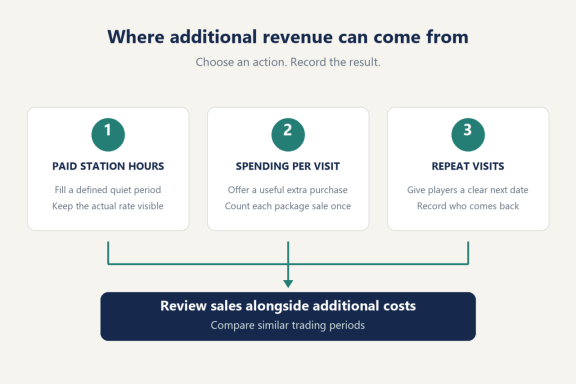
Diagram connecting paid station hours, spending per visit, and repeat visits
2. Give quiet hours a specific offer
Do not discount the whole week to solve an empty afternoon.
Name the period you want to fill, then give a particular group a reason to use it. A team practice block can suit players who want adjacent stations. A quieter open-play session can suit people whose schedules let them visit before the evening rush. Ask existing customers when they can come, rather than guessing from their age or the games they play.
The offer needs a boundary. Decide which days it covers, when play starts and finishes, how many stations you can allocate, and what happens if someone wants to stay longer. A customer arriving near the end of the window should hear the same explanation from every shift.
Consider a hypothetical afternoon with 20 paid hours at USD 6 per hour, earning USD 120. You introduce a USD 5 rate for that same period. Selling the original 20 hours now earns USD 100. Selling 24 hours brings the total back to USD 120. You need more than 24 paid hours to increase gaming revenue, before considering any extra operating costs.
That is the check worth doing before printing the sign.
Ask how many extra hours are plausible in the room you have, and whether some of the customers taking the offer would have paid the standard rate anyway. Track total gaming revenue for the period alongside offer sales. A popular discount can attract attention while mostly moving existing spending onto a lower rate.
Players seated among available gaming stations in a spacious American gaming lounge

Promote the offer where the intended players already hear from you. Put the actual time window on the front-counter notice and your venue's community channels. Tell staff to mention it to customers who ask about quieter sessions. The message should let a player decide whether the visit fits their schedule without sending a series of questions.
Leave room for the next shift. If discounted sessions would run into your busiest period, decide the transition before announcing them. Staff need to know whether the session ends at the advertised time or continues under another clearly explained option.
Give the promotion a place in the weekly routine. Someone needs to check how many stations are ready before accepting a group, and someone needs to remove or update the notice when the offer changes. A counter sign advertising yesterday's arrangement creates an argument at the exact moment a customer is ready to pay.
Ask staff to record why interested players decline. Perhaps the start time is too early for the people you hoped to attract, or a group needs a different day. Those answers are more useful than immediately cutting the price again. Keep them beside the sales figures when deciding whether to change the window.
For an owner working out how to increase internet cafe revenue, the first low-traffic offer should answer a narrow question: can this particular time window attract enough additional paid use to earn more? Keep the other packages steady while you find out.
3. Make session packages easy to choose
A customer at the counter should be able to choose a session without studying a page of overlapping offers. Keep a clear walk-in rate and a small number of packages with a distinct purpose: a short visit, a longer session, or a defined group block.
Write down what the customer receives. Include playtime, eligible stations, applicable hours, and any included item. If a package combines gaming and a drink, keep one total sale in your revenue records and use a consistent method to separate its components when reviewing them. Adding the package total to the full value of its contents would count the same sale twice.
The explanation matters. A staff member should be able to say how much time is included and when it can be used before taking payment. Put the same wording on the sign and in the shift instructions. Avoid a bargain that depends on the customer remembering an exception from a different employee.
Use session billing and member management with iCafeCloud to keep the play records attached to customer sessions. iCafeCloud records sessions and calculates their charges, giving staff a consistent record to work from when checking what was played and billed.
Check package revenue against the hours it sells. A longer session can bring a larger payment per visit while lowering revenue per occupied hour. That may suit a quiet period with spare stations. During a busy period, compare it with the shorter visits those same stations could accommodate.
Review the words customers use at the counter, too. If players repeatedly ask whether a package includes a particular station or time window, rewrite the explanation. Do that before adding another offer.
Check where the choice is displayed. A package mentioned only after a customer has paid is unlikely to shape that purchase. Put the options where players decide how long to stay, and let the employee ask about the intended visit before recommending one. A short visit should still have a straightforward option.
4. Add a purchase that fits the visit
Begin with a small range of packaged drinks and snacks that customers can choose quickly. Keep them visible from the counter, show the prices, and make sure staff know what is available before suggesting a purchase.
The moment to ask is practical. A player arranging a long session may want a drink before sitting down. A group checking in together may prefer to settle its snacks at the same time. Explain the choice once and let the customer decide.
Calculate what remains after buying the stock. In a hypothetical example, a packaged drink sold for USD 3 with a purchase cost of USD 1.25 leaves USD 1.75 before payment fees and other selling costs. Selling ten creates USD 30 of product revenue and USD 17.50 before those other costs. Keep both figures visible when deciding what to reorder.
Restocking deserves a shift task. Empty shelves cannot earn anything, and an overfilled selection ties up cash in products that may expire. Note what sells with longer sessions and which items sit untouched. Keep drinks on a suitable side surface so a small sale does not create a spill over a keyboard.
Treat product sales as their own revenue line. You can then see whether the new choice increased spending per visit without guessing from the gaming receipts.
5. Sell group sessions with a clear scope
A group buys something more specific than a collection of individual walk-ins: a shared time, enough adjacent places, and a plan everyone understands. Make that easy to purchase.
Start with a format your room can comfortably host, such as a birthday group, a team practice session, or an organized evening for a local club. Decide the number of stations and the duration. Write down whether a staff host, food, or extra setup is included, and name the person who will deal with the organizer.
These formats have real venue examples. In California, Cooper's eSports Gaming Center lists group parties and corporate events alongside gaming memberships and food-and-drink benefits. That demonstrates possible offers, not a revenue forecast for your own room.
Price the use of the space as well as the extras. Before accepting a group during a busy period, estimate the ordinary gaming sales those stations would otherwise earn. Compare that with the group payment and the extra staffing or supplies it needs. A large booking total deserves that check, especially if it occupies your most requested stations.
A small group playing at adjacent gaming stations with drinks on a side table

Put arrival and departure times on the confirmation. Ask the organizer to confirm attendance and the intended activity before the session, so the shift can prepare adjacent stations and explain the check-in arrangements. Staff should know what to do if some guests arrive late or the group asks to extend.
iCafeCloud supports session and time control for PCs and consoles. Use those play records alongside your separate event confirmation and service notes to keep the actual session clear. Record separately charged hosting or other services once, rather than adding the full group package again to its included playtime.
After the group leaves, note what took longer than expected. Resetting the area and helping late arrivals are work your next offer needs to account for.
6. Give regular players a reason to book the next visit
Offer a repeatable reason to return: a regular team session, a recurring community gathering, or a member benefit that players can understand. Tell them the next date while they are still deciding when to play again.
Keep the promise manageable. If players return for a shared activity, they need a reliable time and someone responsible for the arrangement. A calendar entry is more useful than a vague promise that there will be another event soon.
iCafeCloud's member discounts and session tracking can support this part of the operation. Its documented discount system applies thresholds based on top-up amounts or accumulated playtime. Choose a benefit that fits what you want to encourage and explain the qualification clearly at the counter.
Watch the visits that follow. Record attendance and member activity so you can distinguish a recurring group from a one-time crowd. Asking how to increase internet cafe revenue should lead to a reason for the next paid visit, with a schedule and an explanation staff can keep consistent.
7. Review what changed before repeating the offer
Give each offer a review date when you launch it. Compare similar days and opening hours, and note holidays, group bookings, or unusual closures that could explain a change. One strong evening is a result to examine, not proof of a lasting trend.
iCafeCloud provides daily reports covering earnings and expenses alongside member activity. Bring those records together with the offer sheet and the additional costs staff recorded. Check gaming revenue against paid hours, then review other sales before looking at the combined result.
If you are planning the operating budget around that workflow, check the current per-PC licensing options. You can also apply for an iCafeCloud trial to work through session records and daily reporting with your team.
Keep the offer if the records support continuing it. Adjust the hours, package contents, or staffing when the extra sales carry too much additional cost. For the next review of how to increase internet cafe revenue, retain the original baseline so the comparison remains useful.
How to increase internet cafe revenue: an action checklist
Before announcing the next offer, check that the person running the shift can answer these six points:
· Which quiet period or spending opportunity are we targeting, and what did it earn before?
· What exactly does the customer buy, including the eligible time and stations?
· How will staff explain the offer and any request to extend a session?
· Where will paid hours and sales be recorded without counting prepaid balances or package contents twice?
· Who records the additional stock, rewards, supplies, and staff time?
· When will we compare the result with similar trading periods?
Give the shift a copy of those answers. Keep it beside the current package information, and leave space for the questions customers ask. Those notes give you a concrete starting point when deciding what to change next.